DICOM SR: AI findings a report can read
An AI result that only a human can read still needs a human to retype it. A radiologist sees "nodule, 8 mm" on screen, then types "8 mm nodule" into the report. Do that 50 times a day and the AI has added work, not removed it. In the previous post in this series, Stop burning AI into the image, we argued that Presentation States are better than burned-in screenshots; but a Presentation State is still meant for human eyes, so it does not solve the retyping.
The DICOM Structured Report does. Herman Oosterwijk explains why in DICOM SR for AI results:
On what an SR gives you
"…the findings and measurements are encoded so they can be interpreted and automatically filled into a report."
He is equally honest about the disadvantage, i.e. that there is no standard display convention for SRs and support in PACS viewers is uneven, which is why he has suggested PR as the safer choice until support improves. So, let's look at what an SR holds, how it reaches the report, and how we use it.
What a Structured Report holds
The SR has been part of DICOM since 2000, so it is not new. The key idea is the template: think of it as an electronic form with a defined structure, identified by a Template ID (TID). A DICOM SR is then a tree of coded content filled in according to that form. (For the wider picture of DICOM objects, see DICOM explained.)
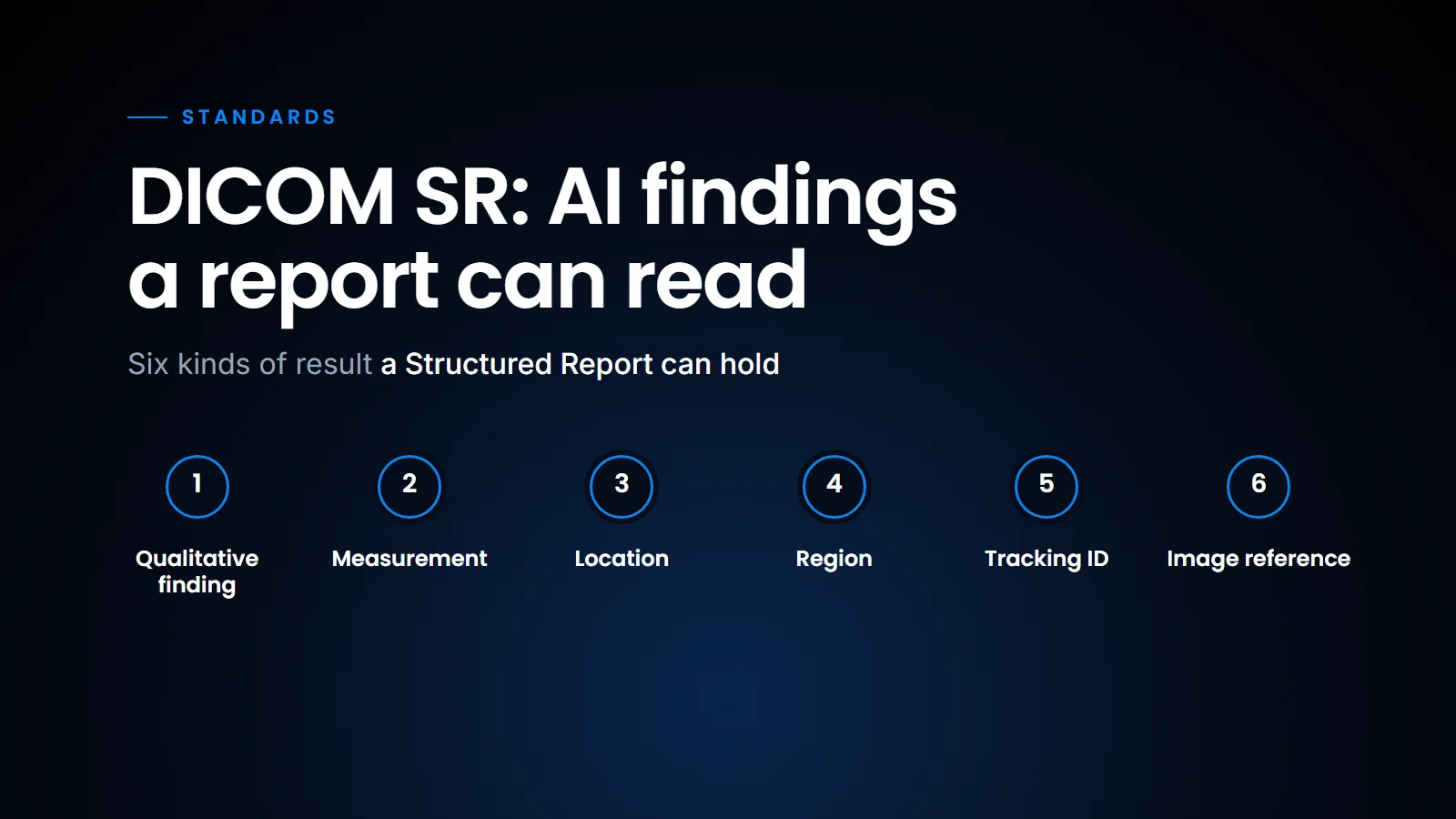
For AI results, the IHE AI Results profile uses the Comprehensive 3D SR object with template TID 1500, the Measurement Report. Each node can hold one of the result types IHE lists:
| Result type | Example |
|---|---|
| Qualitative finding | Pneumothorax: present |
| Measurement | Adrenal nodule length: 52 mm |
| Location | Clot at a 3D coordinate in the patient |
| Region | A lesion outline, or a reference to a SEG |
| Tracking ID | "Primary tumour", followed across studies |
| Image reference | Best view of the haemorrhage |
Items are coded (SNOMED CT, RadLex or DCM), and depending on their type they carry a value, units for a measurement, and a reference back to the image it came from. Software can read it without guessing.
One caution from Herman's article is worth repeating: if an AI product says it "supports SR", ask which kind. A Basic Text SR keeps a structured outline with coded headings and image references, but it cannot hold numeric measurements or spatial coordinates, so for AI measurements it is not much more useful than text. A Comprehensive SR with TID 1500 is what you want for measurements.
From SR to the report
Many reporting systems do not speak DICOM. Herman points out that SR content can be easily mapped into a FHIR message, or if necessary an HL7 v2 message, which makes FHIR the cleaner bridge: each SR finding maps to a FHIR Observation, and the image link maps to an ImagingSelection. That is an industry standard, not another custom API. We will go through that mapping in detail in a later post.
A coded SR finding reaches the report as FHIR data the radiologist confirms.
How SOMATIQ uses it
In SOMATIQ, the viewer, the RIS and the reporting tool are one platform. That is the point of building them together, and it is a large part of what we mean by AI-native. (The more general division of labour between RIS and PACS is in RIS, PACS or RIS-PACS.) A finding the viewer displays can flow into the report as data, so the radiologist confirms it instead of retyping it. The platform also supports HL7 and FHIR integration with a hospital's HIS or EMR, so the same structured result can travel onward after sign-off.
In SOMATIQ the finding flows into the report as data, and the radiologist signs.
The Trinity Reporting Engine by SOMATIQ, our reporting tool, is built around that idea: fewer keystrokes between what the AI found and what the radiologist signs. LLM-assisted drafting turns the structured findings into a first draft for the radiologist to edit, and the radiologist remains the one who signs. Its first version drew more than 100 sign-ups at IRIA 2026, which we describe in What radiologists told us at IRIA 2026.
So where does that leave a centre buying AI? The practical upshot is that SR is the format that turns AI from something to look at into something the report can use. Ask for TID 1500 output, check that your viewer can display it sensibly, and make sure your reporting system can read it, directly or through FHIR. If any of the three is missing, the radiologist is back to retyping.
| Ask for | What to confirm |
|---|---|
| TID 1500 output | The AI result arrives as a DICOM SR |
| Viewer display | Your viewer can display it sensibly |
| Report reading | Your reporting system can read it, directly or through FHIR |
If any of the three is missing, the radiologist is back to retyping.
Related reading
- Stop burning AI into the image — Presentation States, the step before SR.
FAQ
What is a DICOM Structured Report?
A DICOM object that stores findings, measurements and image references as coded, machine-readable content.
What is TID 1500?
The DICOM Measurement Report template. The IHE AIR profile uses it for AI results.
How does an SR reach a report?
Through a reporting system that reads DICOM SR, or by mapping SR content to FHIR Observation resources.
Is every "SR" from an AI vendor the same?
No. A Basic Text SR has structure and image references but no numeric measurements or coordinates. For measurements and findings, ask for a Comprehensive (or Comprehensive 3D) SR using TID 1500.
Ready to see your workflow on one platform?
We will walk you through the whole workflow, from registration to signed report.