Is your RIS-PACS AI-native, or just AI bolted on?
RIS, PACS, reporting and AI on one architecture, so the AI works inside your worklist, viewer and report instead of beside them.
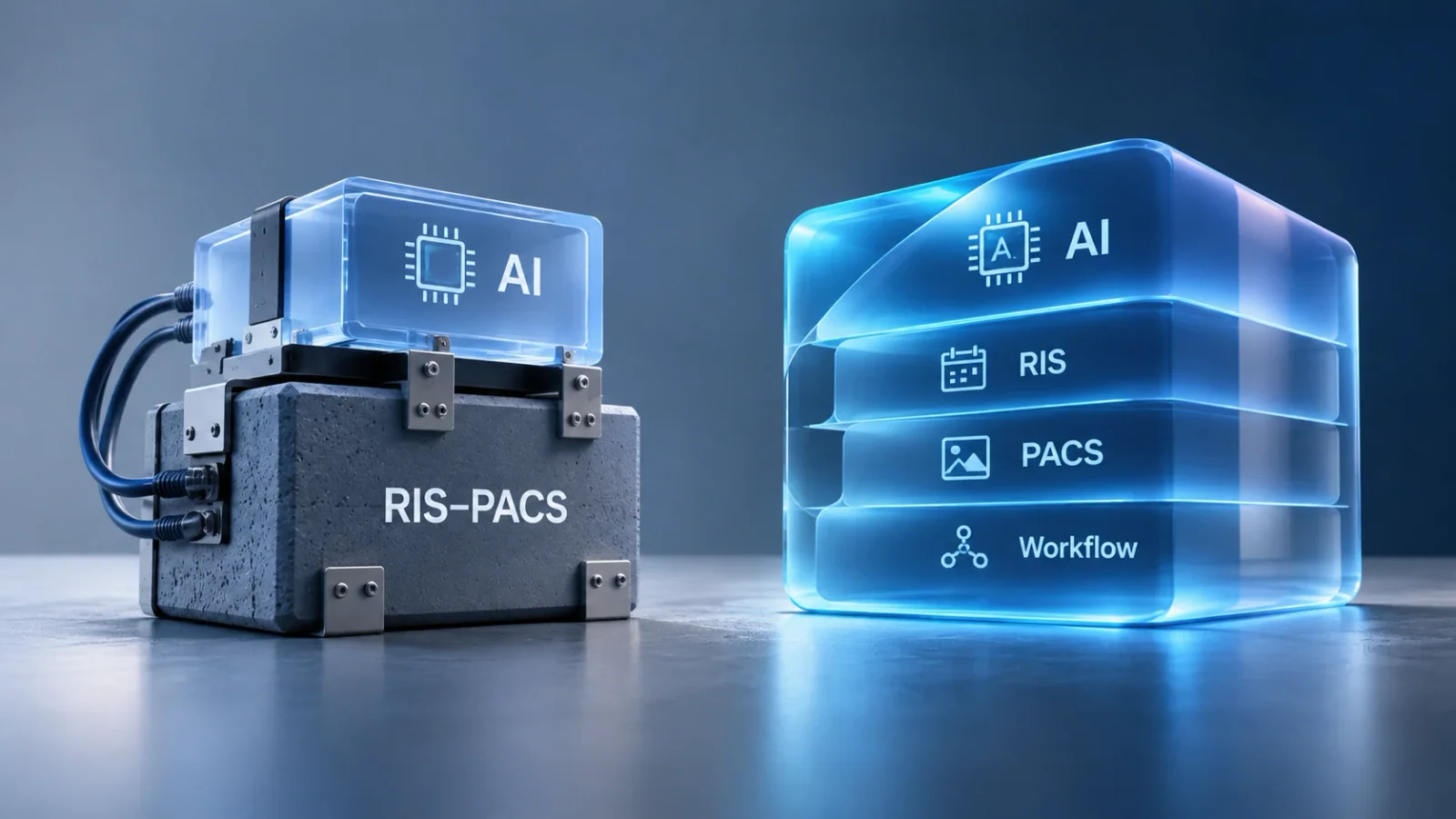
An AI-native RIS-PACS is one radiology platform where the RIS, PACS, reporting and AI share one architecture and one data layer. The AI shows up where the radiologist already works, not in a separate product joined by integrations. This page explains how that differs from a PACS with an AI plugin, the terms buyers come across, and what to check when a vendor uses the word.
The problem
- Software grew in layers. A RIS for registration and billing, a PACS for images, a reporting tool, sometimes Word. Then AI arrived as one more product, connected by an interface.
- Every join is a delay. A study waits between systems, a name gets retyped, or an AI result lands in a window nobody has open.
- Cloud alone doesn't fix it. Herman Oosterwijk notes in What's beyond PACS 3.0? that much cloud PACS is still the same software running in a virtual machine on someone else's server. "AI-native" is one answer: build the platform so intelligence is part of the workflow from the start.
AI-native vs bolt-on AI
| Bolt-on AI | AI-native | |
|---|---|---|
| Where AI lives | A separate product talking to RIS and PACS | Inside the same platform as worklist, viewer and report |
| Logins | One per system | One |
| Patient data | Copied between systems, matched by ID | One record, one data layer |
| Adding an AI capability | Another integration project | A change in the same platform |
| Where the result appears | Often another window | In the viewer or report the radiologist already has open |
Bolt-on AI has one real advantage: you can add it without replacing anything. Its cost is that every join is a place where a study waits, a name gets retyped or a result goes unseen.
Related terms
Unified RIS-PACS. RIS and PACS on one platform with one patient record and one login, from registration to signed report. A unified system is not necessarily AI-native; AI-native implies unified.
Agentic RIS-PACS. A RIS-PACS where software can carry out multi-step tasks on a user's request, such as finding a case or moving through the worklist, while the radiologist stays in control and signs every report.
Voice-controlled RIS-PACS. A system the radiologist can talk to: open the next case, navigate the worklist, dictate the report, hands-free.
Zero-footprint viewer. A DICOM viewer that runs in a web browser with nothing installed on the reading machine. It can render on the client or stream from a server.
What to look for
- One path, one login. Ask to see a study go from registration and billing through the modality worklist, the viewer and the report to delivery, without retyping or a second login.
- AI where the radiologist works. The AI result should appear in the worklist, viewer or report, not in another application.
- The radiologist signs. AI-native is not autonomous reporting. Ask how drafts are reviewed and who signs.
- Standards outward. DICOM for any modality, HL7/FHIR to the HIS, and full export if you leave.
- Your own studies. Ask for the demo on a heavy CT from your own scanner, on your own connection.
How a study moves
Register and bill
One patient record and one login
Scan
The exam appears on the scanner's worklist; images go to the archive
Read
In the browser viewer, with priors; talk to the worklist hands-free
Report and sign
Voice and LLM-assisted drafting flag problems; the radiologist signs
Deliver
To the patient by WhatsApp or email, to the doctor with a study link
Ready to see your workflow on one platform?
We will walk you through the whole workflow, from registration to signed report.