RIS, PACS or RIS-PACS?
By SOMATIQ team ·
Most centre owners we meet have bought a PACS, a billing package and a reporting template in Word, at different times, from different people. Then someone asks whether they need a RIS, and the honest answer is that they already have one. It is just spread across the front desk register, the billing software, a shared folder and a lot of phone calls.
So before comparing products, it helps to be clear about what each system is supposed to do.
What a RIS does
A Radiology Information System runs the patient and paperwork side of the department. In a typical Indian diagnostic centre that means:
Registration: patient demographics, referring doctor, patient ID, and increasingly the ABHA number.
Scheduling: which scanner, which slot, prep instructions for contrast studies, reminders.
Billing: tariffs, package rates, corporate and insurance tie-ups, discounts, refunds, referral tracking.
The worklist: sending the scheduled exam to the modality so the technician does not type the patient's name on the console.
Reporting: templates, drafting, sign-off, addenda, and the radiologist's queue.
Report dispatch: printing, email, SMS or WhatsApp links to the patient and the referring doctor, and the delivery record.
The RIS is where turnaround time is born and measured. If you want to know how long CTs waited for a report last Tuesday, that number lives in the RIS.
What a PACS does
A Picture Archiving and Communication System handles the images. It receives DICOM studies from CT, MRI, X-ray, ultrasound and mammography; stores them; lets radiologists and clinicians view them; and keeps them retrievable for years. Good PACS work is mostly invisible: studies arrive, priors are there, the viewer opens fast, and nothing gets lost when a disk fails.
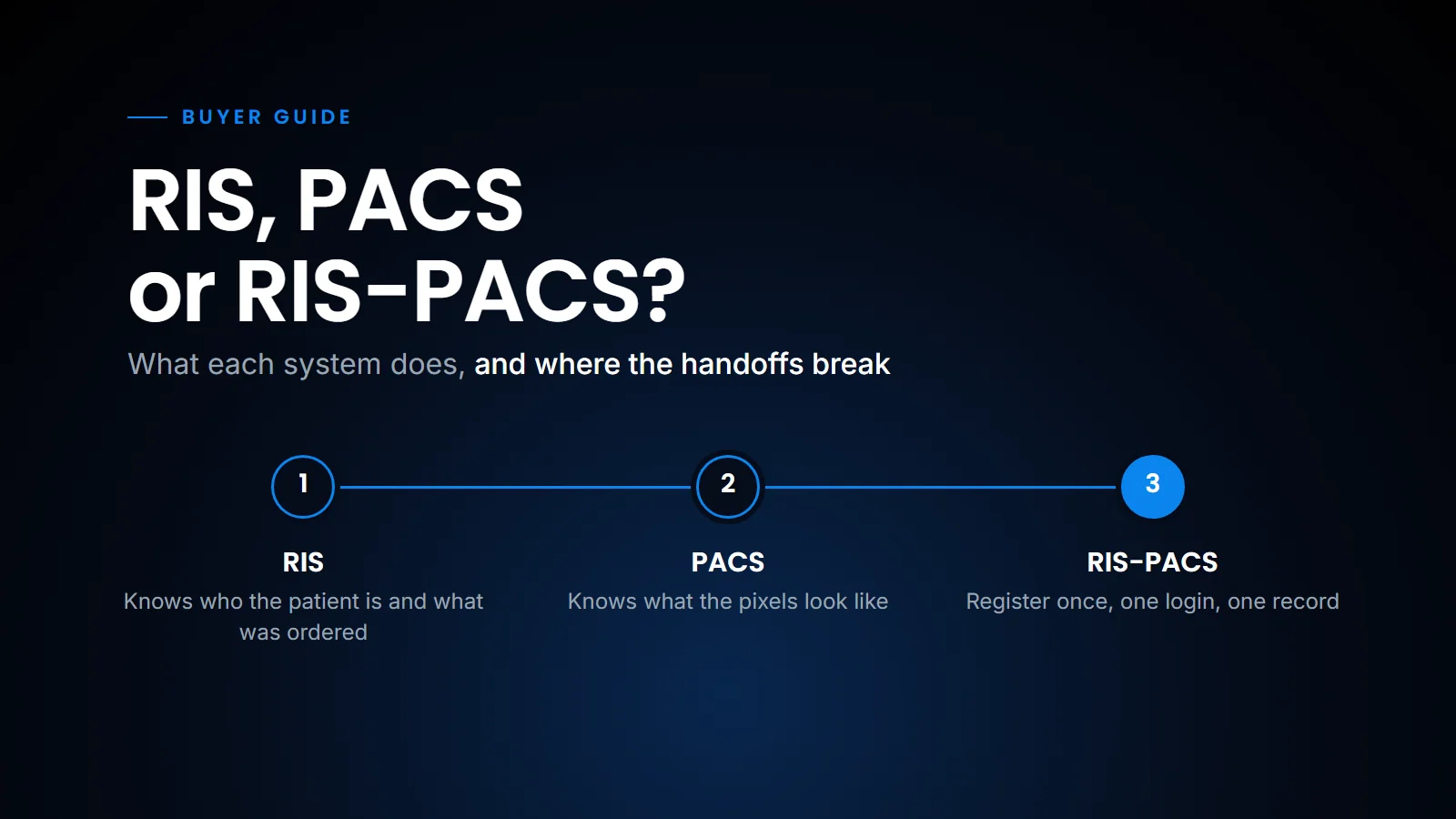
Put simply, the RIS knows who the patient is and what was ordered. The PACS knows what the pixels look like. The report needs both.
Where the handoffs break
The RIS handles patient and paperwork, the PACS handles images; the accession number ties them together.
The trouble is never inside one system. It is at the joins. These are the ones we see most in Indian centres.
Retyping. The front desk registers the patient in billing software. The technician types the same name and age again on the CT console because the modality worklist was never set up. Now "Ramesh K" in billing is "RAMESH KUMAR" in PACS, with a different ID. Every manual re-entry is a chance for a wrong name, wrong age or wrong side on a report.
Multiple logins. The radiologist logs into the PACS viewer to see images, a separate reporting tool or Word to type, and the RIS or HIS to mark the report final. Three windows, three passwords, and a copy-paste in between. Across a few hundred studies a day, that is a real number of minutes lost per radiologist per shift. Radiologists at our IRIA stall made the same point in fewer words: radiology needs fewer clicks (what radiologists told us at IRIA 2026).
Priors that don't show up. The patient had a CT at your other branch eight months ago. If the two branches run separate PACS, or if the IDs don't match, the radiologist either doesn't see the prior or spends time hunting for it. A comparison report without the comparison is a weaker report.
Report dispatch outside the system. The report is signed in one place, exported as a PDF, and sent from someone's phone. Nobody can later tell, from the system, whether the referring doctor actually received it.
Billing and reporting out of sync. A study is billed but never reported, or reported but the bill was cancelled. Reconciling this at month end is a spreadsheet job that someone in accounts dreads.
None of these are exotic. They are what happens when a RIS and a PACS are bought separately and connected with goodwill instead of standards.
What a single-centre lab needs
A single centre with a few modalities, say a 1.5T MRI and a 16- or 32-slice CT plus X-ray and ultrasound, does not need an enterprise project. It needs:
- Registration and billing that feed the modality worklist, so the technician picks the patient instead of typing.
- A PACS with enough storage for at least a few years of studies, and a plan for what happens when it fills up.
- A reporting tool where templates, images and sign-off are in one screen.
- Report dispatch that is logged.
- Remote reading, because sooner or later a visiting or night radiologist will report from home (or a teleradiology partner will).
For a centre like this, separate RIS and PACS from two vendors can work if the integration is done properly and someone owns it. In practice, small centres rarely have an IT person to own it, which is why the joins fail quietly.
What a multi-centre chain needs
Once you have three, five or eight centres, the questions change.
One patient identity across centres. The same patient walking into two branches should be one record, not two.
Priors across the network. A radiologist at branch A should see the study from branch C without anyone emailing a CD.
Central worklist and load balancing. Radiologists sitting anywhere should be able to pick up studies from any centre, by modality and priority.
One login. Not one per branch.
Consolidated reporting on turnaround, volume and revenue across all branches, from one place.
Consistent templates and tariffs, managed centrally, with branch-level exceptions.
At this size, a stitched-together setup gets expensive in ways that don't show on the invoice: duplicate IDs, lost priors, and coordinators whose whole job is moving information between systems.
What "unified" should actually mean
Every vendor now says "integrated" or "unified RIS-PACS". It is worth testing what they mean, because sometimes it means two products sold on one invoice with an HL7 interface between them.
A unified system, in the sense that matters to a centre, should pass these tests:
Register once. Patient details entered at the front desk appear on the modality worklist and in the report header without anyone retyping them.
One login. The radiologist opens the worklist, the images, the priors and the report editor without switching applications or signing in again.
One patient record across centres, with priors from every branch showing up automatically.
One audit trail from registration to signed report to delivery, so you can answer "who changed this report, and when" without asking two vendors.
Still speaks standards. Unified does not mean closed. It should accept DICOM from any modality, send and receive HL7 or FHIR with your HIS, and let you export your data if you ever leave. We will cover what DICOM is and how HIS PACS integration works in later posts.
If a vendor can show all five on a live demo with your own studies, it is unified. If they need a slide to explain it, it probably isn't.
How SOMATIQ approaches this
We built SOMATIQ as one platform for RIS, PACS and reporting rather than separate products joined later. A centre, or a chain of centres, can run the whole cycle on one system: registration, scheduling, billing, acquisition, reporting and report delivery, with one login for the radiologist and priors available across the network. It feeds the modality worklist, connects to a hospital's HIS over HL7 or FHIR, and delivers reports to patients and referrers by email and WhatsApp. The reasoning behind building it this way is in Why we built SOMATIQ and What "AI-native" RIS + PACS means.
A quick decision guide
| Your situation | What you likely need |
|---|---|
| One centre, PACS already working, billing software you like | Make sure the modality worklist is fed from registration; add a reporting tool that sits on the same images |
| One centre, starting fresh or replacing an old PACS | A unified RIS-PACS; it removes the integration you would otherwise have to maintain |
| Two to four centres, separate systems at each | Priority is a single patient identity and shared priors; unified is usually cheaper than integrating every pair |
| Five or more centres, central reading team | Unified platform with central worklist, one login, network-wide priors and consolidated reporting |
| Hospital radiology department with an existing HIS | RIS-PACS that integrates with the HIS over HL7/FHIR, with the HIS remaining the master for patient and orders |
So where does that leave a centre owner? The RIS and the PACS do different jobs, and both are needed; the real decision is how they are joined. Separate systems have the advantage that each can be chosen on its own merits, but the disadvantage is that someone has to own every join between them, and in most Indian centres nobody does. That is why, for chains and for centres without in-house IT, we suggest starting from a single platform and testing it against the five checks above with your own studies.
Further reading
- Unified RIS-PACS versus separate systems — compare workflow, integrations and support.
FAQ
What is the difference between RIS and PACS?
A RIS manages patients, orders, scheduling, billing, reporting and report delivery. A PACS stores, displays and archives the medical images. The RIS knows what was ordered for whom; the PACS holds what was acquired.
Do I need a RIS if I already have a PACS?
If your registration, billing and reporting already happen in some software, you have a RIS of sorts. The real question is whether it is connected to your PACS so that patient details flow to the modality and the report without retyping.
Is an integrated RIS-PACS better than separate systems?
For a single centre with a capable IT person, separate systems connected through proper standards can work well. For multi-centre chains, or centres without in-house IT, a single platform usually removes more problems than it creates, as long as it still supports DICOM, HL7 and data export.
Can a hospital HIS replace a RIS?
Some HIS products include basic radiology order and billing modules, but they rarely handle modality worklists, radiologist worklists, structured templates and prior comparison well. Most hospitals keep the HIS as the master for patients and orders and use a RIS-PACS for the radiology workflow.
Ready to see your workflow on one platform?
We will walk you through the whole workflow, from registration to signed report.