Why we built SOMATIQ
A question I get often, usually from radiologists, is why an engineer started a radiology company. The honest answer is partly personal and partly technical. I wrote it down for SOMATIQ's launch in January 2026, and I am putting that article here more or less as I wrote it. Around it I have added some context for readers of this site who do not work in radiology, and a few practical points for centre owners at the end.
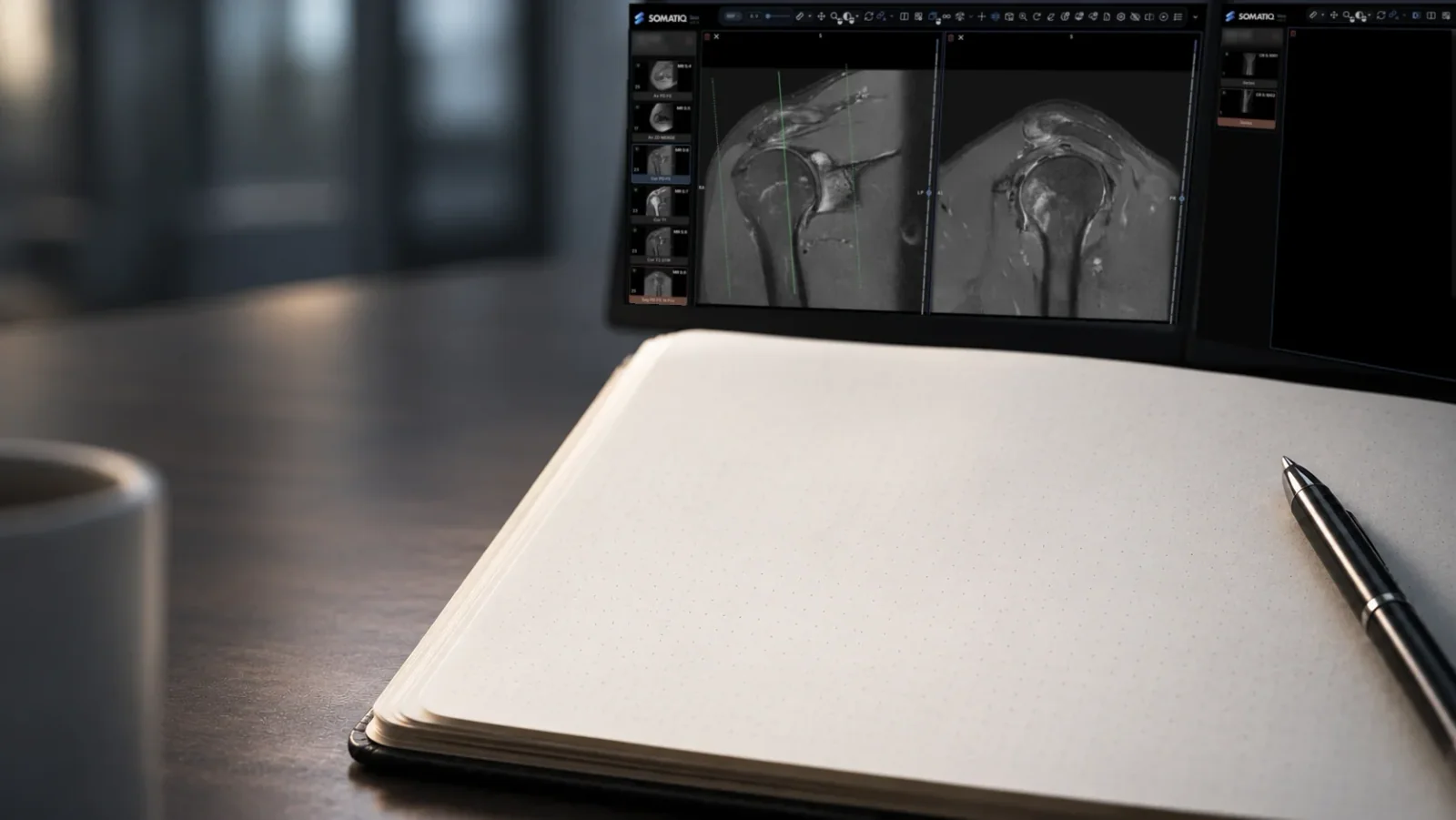
A pain you can't unsee
How it began
Some startups launch with a pitch deck. Mine - with a pain you can't unsee.
I grew up in a small, rural agricultural town in Tamil Nadu. In a place like that, you learn very quickly that "access" is the difference between life and death. I watched people very close to me lose their lives simply because they couldn't get to good healthcare in time.
That experience stays with you.
I found my way into a good education in Computer Science Engineering and specialised in AI. That contrast hit hard: we can build systems that write code, see patterns in images, and automate complex workflows… but we still accept broken healthcare infrastructure as "normal." That never made sense to me. So I made it my mission to use AI and technology to improve healthcare worldwide, starting with a deep focus on India.
What access looks like in radiology
First, a few words about what "access" means once a scanner exists. For a family in a small town, it is no longer only about whether there is a CT or an MRI nearby; increasingly, there is. The harder part is everything after the scan. The images have to reach a radiologist, often one sitting in another city. The radiologist has to find the case, open it, see the old scans (we call them priors), write the report and sign it. Then the report has to get back to the doctor who asked for it, and the patient has to be registered, billed and informed along the way.
Every one of those steps runs on software. When the software is slow, or split across systems that do not talk to each other, the delay is not visible to the patient; they simply wait. A delayed workflow becomes a delayed diagnosis, almost invisibly. That is the connection between where I grew up and what we build.
The hard problem was not the algorithm
Three years ago, when I started building AI for radiology, I thought the hard problem was the algorithms. I was wrong.
The real problem was that the software infrastructure underneath is crumbling. Radiologists across India work with systems that fight each other - RIS in one corner, PACS in another and AI as an afterthought. Instead of saving time, these tools add insane friction. Instead of preventing burnout, they cause it.
No modern RIS/PACS exists in India. The options available lack both robust products and reliable support.
I put it more bluntly in the launch post: AI is only as good as the infrastructure it runs on. You can build a very good model and still have it sit unused, because the radiologist has to leave their PACS, open another window and log in again to see what it found. The model may be accurate, but if it lives outside the place where the radiologist works, it is not part of the read. I explain the alternative we chose in What "AI-native" RIS + PACS actually means.
Meeting Vishwanath
Then I met Vishwanath R S, MD, CIIP.
He's a radiologist with deep expertise in healthcare informatics. He has significant experience in building AI models for global OEMs. But his day-to-day experience in the reporting room made one thing brutally clear: Radiologists don't need another AI add-on. They need better workflow tools. Without that foundation, AI is just a gimmick.
Six months ago, what started as a brainstorming conversation turned into something real.
Today, I'm excited to announce the launch of SOMATIQ - India's first AI-native RIS + PACS platform.
The name says what we set out to do: SOMA for body, IQ for intelligence. Vishwanath is a practising radiologist who has read more than 100,000 scans and is a Certified Imaging Informatics Professional (imaging informatics being the discipline that sits between radiology and IT). I am an engineer and data scientist. Between the two of us, one knows what the reporting room actually feels like and the other knows how to build the system underneath it. We needed both, and I suspect most radiology software that disappoints its users was built with only one of the two in the room.
What we believe
We don't believe in the goal of "replacing" doctors with autonomous reporting. We started with a simpler, but a more powerful belief:
AI should support radiologists, not disrupt how they work. So we built AI into the core architecture, not as a plugin. It is designed to make experts more effective.
The argument in one line
Integration is not a feature. Integration is the product.
The proof is in the pudding
With no marketing and sales, we are already deployed across 25+ diagnostic centres and hospitals, including one of Bangalore's largest diagnostic chains.
What this means for a centre
If you own a centre, especially outside the metros, the radiologist reading your scans may never visit your building. What decides how quickly your patient gets an answer is how quickly a study moves from your scanner to that radiologist's screen, and how much of their time goes into reading rather than hunting for priors, retyping details or switching applications.
So when you look at radiology software, look at that chain end to end: registration, scheduling, billing, acquisition, reporting and report delivery. How many systems does a study pass through? How many logins? Where do previous scans live? The answers decide your turnaround time more than any single AI feature will. (At RSNA 2025 I saw the same lesson from the other side: the AI that drew the crowds was the kind that asked the least change of the radiologist.)
The future can't come soon enough
The future of radiology lies in AI-native platforms that quietly make experts more effective - helping them work faster, avoid burnout, and ultimately improve patient outcomes. For every family in a small town waiting on a diagnosis, that future can't come soon enough.
Let's build the radiology infrastructure India deserves.
Related reading
FAQ
Who founded SOMATIQ?
Naveen K, an engineer and data scientist who has spent about three years building AI for radiology, and Dr. Vishwanath R S, MD, CIIP, a practising radiologist and Certified Imaging Informatics Professional. The company started around August–September 2025 with a three-member team and launched publicly in January 2026.
What does the name SOMATIQ mean?
SOMA means body and IQ stands for intelligence.
What problem is SOMATIQ trying to solve?
Radiology software in India is split across systems that do not work well together: RIS, PACS and AI as an afterthought. That adds friction for radiologists and delay for patients. SOMATIQ puts registration, scheduling, billing, images, reporting and report delivery on one platform with AI built into the architecture.
Does SOMATIQ want to replace radiologists?
No. The belief from day one has been that AI should support radiologists, not disrupt how they work, and make experts more effective.
Ready to see your workflow on one platform?
We will walk you through the whole workflow, from registration to signed report.