What "AI-native" RIS + PACS actually means
What is an AI-native radiology platform?
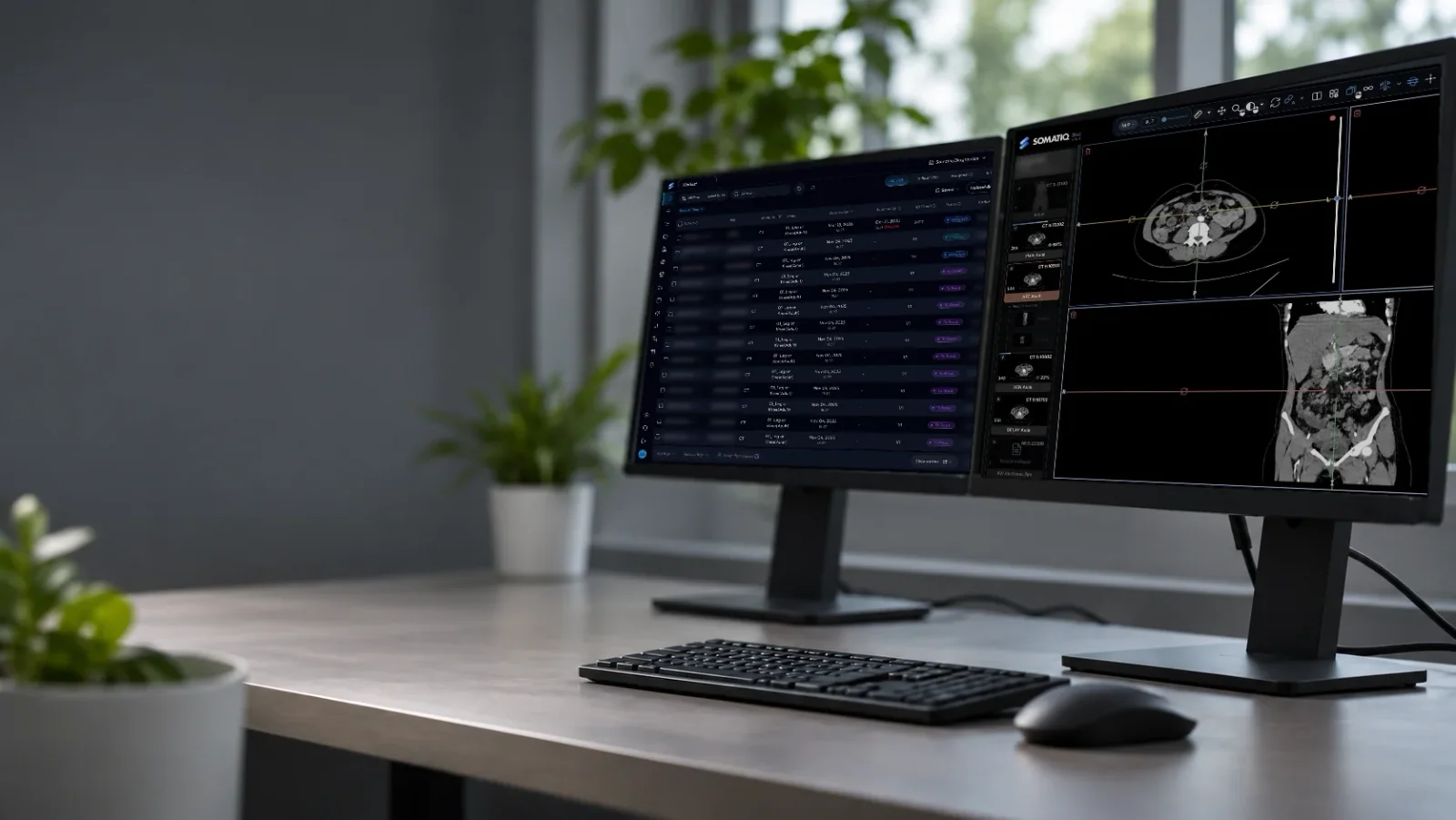
Most imaging centres in India run their radiology on two or three separate products. A RIS (radiology information system) registers the patient, schedules the scan and handles billing; a PACS (picture archiving and communication system) stores and displays the images; and the report is often written somewhere else again, sometimes in Word. When AI arrives, it usually comes as one more product, connected to the others by an integration. The advantage of this approach is that a centre can add AI without replacing anything. Its disadvantage is that every connection is another place where data waits, gets retyped or goes missing, and another window the radiologist has to open.
An AI-native radiology platform takes the other route. It is one system that runs RIS, PACS and reporting together, with AI built into the same architecture from the start instead of bolted on later as a separate plugin. Scheduling, billing, images, the worklist, the report and the AI share one data layer and one login. The AI does not have to be "integrated" with the workflow, because it is part of it.
So, let's go over what that means. Below is the post I wrote to announce SOMATIQ's launch, kept almost exactly as it was. After it, I describe what "native" looks like inside a centre on an ordinary day, and answer the questions people ask us most.
The radiology AI market has a platform problem
The radiology AI market has a platform problem. It is costing radiologists' time. It is causing delayed diagnosis. It is leading to poor patient outcomes.
Vishwanath R S, MD, CIIP and I are fixing it.
Everyone in health-tech is talking about AI in radiology. At RSNA 2025, the AI booths looked eerily similar: algorithms to detect nodules, flag anomalies and a promise of autonomous reporting. The investors are loving it.
But there's negligible adoption in India. Why?
AI is only as good as the infrastructure it runs on. And in India, that infrastructure is broken.
Most radiology workflows today are fragmented by design.
Each tool adds latency. Each integration adds friction. The radiologist, caught in the middle, spends more time navigating software than reading scans.
This is an architectural failure. Radiology doesn't need better AI. It needs a platform shift.
Today, I'm announcing the launch of SOMATIQ - India's first AI-native RIS + PACS platform.
The key word is "native"
We didn't build a PACS and then add AI. We didn't build AI and then look for a PACS to integrate with. We built a single, unified platform where AI is part of the architecture from the ground up.
The key idea
Workflow and intelligence are not separate layers - they're the same layer.
…integration is not a feature. Integration is the product.
The future of radiology is not AI that replaces radiologists. It's AI-native platforms that make radiologists genuinely more effective.
Why the add-on model hurts on a normal day
When I say "fragmented by design", I mean something very ordinary. A patient is registered and billed in one system. The images land in another. The report is written in a third, sometimes in Word and then pasted across. The AI result, if there is one, sits in yet another window.
Every hand-off between these is an integration someone has to build, maintain and debug, and each one has its own failure mode (a mismatched patient ID, a study that never arrives, a report that has to be retyped).
On the radiologist's side, it shows up as extra clicks, extra logins and time spent hunting for previous scans. Each one is small. Across a few hundred studies a day, they add up to hours. Adding an AI plugin on top of that stack usually adds one more integration, and often one more window; even when the results are shown well inside the viewer, it does not remove any of the other seams. That is the part that is easy to miss when AI is sold as a separate product.
What "native" means in practice
Here is what it looks like inside SOMATIQ today. These are things a radiologist or centre owner can see, not architecture diagrams. The platform is characterised as follows:
- One platform from registration to signed report. Registration, scheduling, billing, acquisition, reporting and report delivery run on the same system, with a modality worklist feeding the scanners, one login across centres and priors available across the network.
- The viewer is ours, and it runs in the browser. The SOMATIQ Unified RIS-PACS includes our own zero-footprint DICOM viewer and our own archive, both built in-house, with rendering on the client. It handles 3D/MPR and custom hanging protocols, and opens on a tablet or phone as well as a workstation.
- Reporting sits beside the images. Built-in speech-to-text, and LLM-assisted report drafting with impression checks and inconsistency detection, work inside the same screen; the radiologist still reads every image and signs every report.
- You can talk to the worklist. Radiologists can use voice to work the worklist and navigate cases hands-free, with fewer repetitive clicks.
- The viewer can be shared. The collaborative viewer lets a radiologist securely share their viewer and work through a case with peers.
- Referring doctors get a link. Study links and reports can go to referring doctors and patients on WhatsApp or email, instead of a photo of the monitor.
- Advanced reading stays in the same viewer. PET/CT fusion and 3D lesion segmentation using a threshold, in the browser viewer.
- It connects outward through standards. HL7 and FHIR integration with the hospital's HIS, EMR and LIS, so the platform does not become another island.
- A new centre joins, it does not get "integrated". When a chain opens another centre, it is added to the system already running, not set up as a separate installation. Medium and large centres can keep an on-site PACS with cloud access; small centres can run cloud-only with a lightweight pusher app.
The same platform is packaged three ways: the SOMATIQ Unified RIS-PACS (with the viewer), TelePractice (for teleradiology) and the Trinity Reporting Engine by SOMATIQ (a standalone reporting tool for radiologists who only need reporting).
AI-native vs AI added on
The difference is easiest to see side by side. On the left, each product is a separate hop with its own login and its own integration; on the right, the same functions live in one layer.
Bolt-on AI adds a system and a login at every hop; AI-native keeps everything in one layer.
| AI added on | AI-native | |
|---|---|---|
| Where AI lives | A separate product talking to RIS and PACS | Inside the same platform as the worklist, viewer and report |
| Logins | One per system | One |
| Priors | Depends on which system holds them | Available across the network |
| Adding a new AI capability | Another integration project | A change in the same platform |
| Adding a centre | Another set of systems to connect | The centre joins the existing system |
What this means for a centre
If you run a centre or a chain, the useful question is not "does it have AI?" Almost everyone says yes. Ask how many systems a study passes through between registration and the signed report, and how many logins your radiologist needs to get there. Ask where the AI result shows up and whether the radiologist has to leave the viewer to see it. Ask what happens to your setup when you open the next centre. (I wrote about why these questions matter to me personally in Why we built SOMATIQ.)
The practical upshot is that the fewer seams there are in those answers, the less time your radiologists spend fighting software, and the more time they spend reading scans. AI that lives inside the worklist, viewer and report is simply more likely to be used than AI that lives in another window.
Related reading
FAQ
What is an AI-native RIS + PACS platform?
It is a single platform where RIS, PACS, reporting and AI are built together on one architecture, instead of separate products connected by integrations. Workflow and intelligence are the same layer, so AI works with the worklist, images and report directly.
Is AI-native the same as autonomous reporting?
No. The radiologist still reads the images and signs the report. The goal is AI that makes radiologists more effective by removing the friction around the read, not AI that replaces them.
How is it different from a cloud PACS?
A cloud PACS can simply be older PACS software hosted on a cloud server, with RIS, reporting and AI still separate. AI-native describes how the platform is designed, with all of these built as one, not only where it is hosted.
What does SOMATIQ include?
The SOMATIQ Unified RIS-PACS (with our own browser DICOM viewer), TelePractice (teleradiology platform) and the Trinity Reporting Engine by SOMATIQ (standalone reporting tool). The platform covers registration, scheduling, billing, acquisition, reporting and report delivery. SOMATIQ is deployed in imaging centres across India.
Ready to see your workflow on one platform?
We will walk you through the whole workflow, from registration to signed report.