How to choose a PACS in India
By SOMATIQ team ·
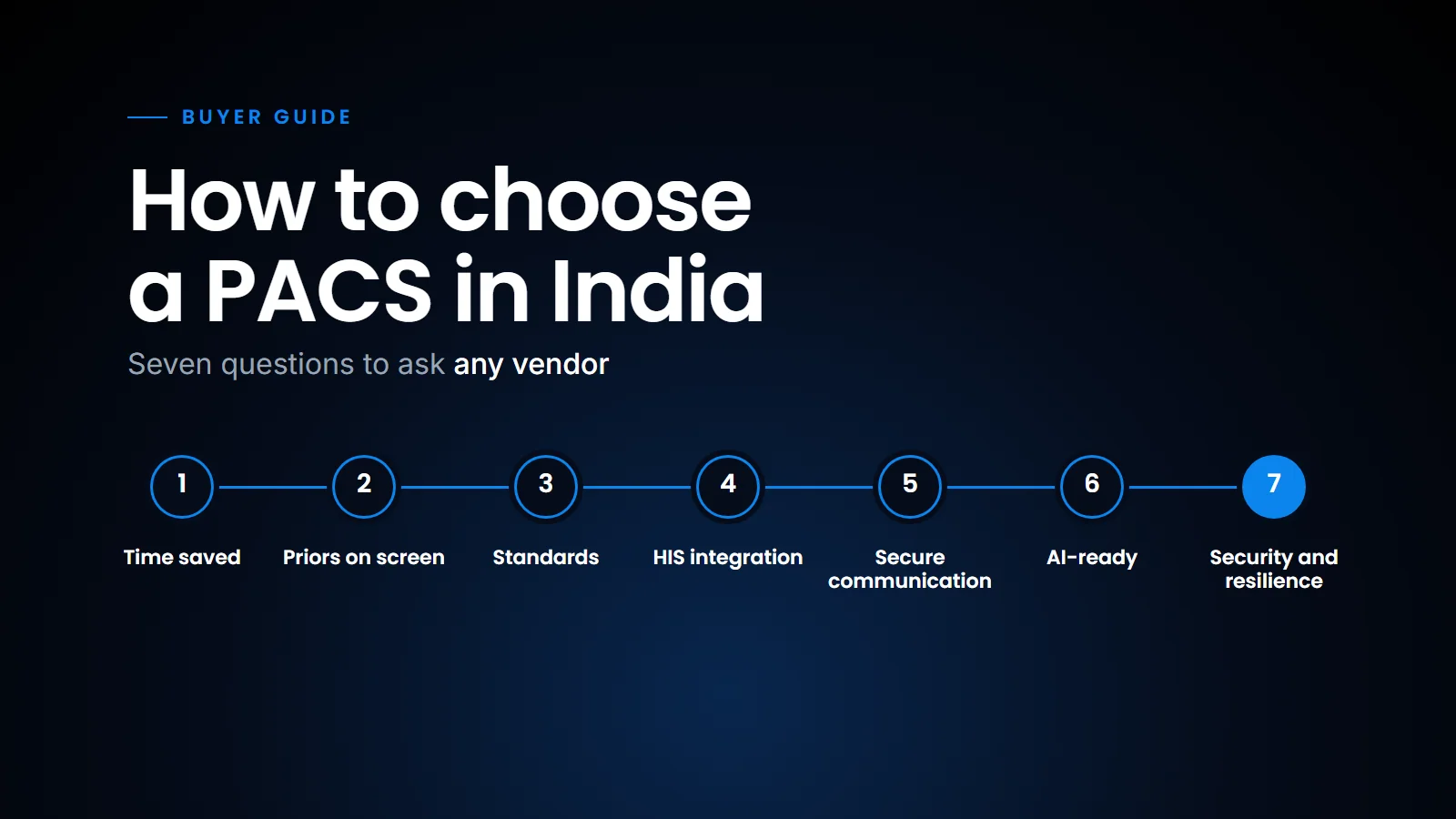
There is no single best PACS software for India. There is a PACS that fits how your centre works, your volumes, your radiologists and your budget, and a lot that don't. The way to find yours is to ask better questions than the ones most tenders and sales meetings start with.
Our CEO, Dr. Vishwanath R S, a practising radiologist, put the usual starting point bluntly in a recent LinkedIn post, which we published here as The real total cost of radiology software:
On how procurement starts
"Yet procurement still opens with: "What is your lowest price?" Or: "Do you have at least 10 years of experience?" Imagine choosing a phone because the vendor has sold phones for twenty years. That is one way to end up with a very reliable feature phone in a smartphone era."
Price and track record matter. They are just poor first filters. A vendor's age tells you little about whether their viewer opens a 2,000-slice CT before the radiologist gives up.
In the same post he listed the questions worth asking instead. We have built this checklist around them, and added the practical items we see centres miss when they sign.
1. How much time does it save?
This is the question Dr. Vishwanath puts first, and it is the one most demos avoid. Ask the vendor to show, on a live system, the full path for one study: registration and billing, modality worklist, images arriving, opening in the viewer, report drafted from a template, signed, and delivered. Count the clicks and the logins. Then ask them to do it again for an addendum.
What you are looking for: no retyping of patient details, one login for the radiologist, and reporting in the same window as the images.
2. How fast are priors on screen?
A report without comparison is weaker, and radiologists will skip a prior that takes a minute to load. Ask:
- How are priors matched? By patient ID only, or with checks on name and date of birth?
- Do priors from your other branches show up automatically?
- How long does a prior CT from last year take to open? Watch it, don't take a number on a slide.
- What happens when a prior is in older, cheaper storage? Does it slow down to minutes?
We go into why this matters clinically in Priors on screen.
3. Does it follow healthcare interoperability standards?
The standards that matter are DICOM, HL7/FHIR and IHE. In practice that means:
DICOM for receiving, storing, querying and sending images. Ask for the vendor's DICOM conformance statement, the document that lists exactly which DICOM services and object types it supports. A vendor who cannot produce one is a warning sign. Our guide on what DICOM is explains how to read one.
DICOMweb (QIDO-RS, WADO-RS, STOW-RS, defined by the DICOM standard) for web and cloud access, and for plugging in AI tools later.
HL7 v2 and FHIR for orders, patient updates and results to and from your HIS.
IHE profiles, especially Scheduled Workflow, which describes how orders, worklists and images should flow between systems. The IHE Radiology technical framework is public.
Standards are what let you leave a vendor without losing your data.
4. Can it integrate seamlessly with your HIS and other clinical systems?
If you are a hospital, or a centre that takes orders from partner hospitals, ask for a reference site where the PACS talks to an HIS like yours. Ask who writes and maintains the interface, and whether that is in the price. More detail in our guide on HIS PACS integration.
5. Does it enable secure communication instead of pushing conversations to WhatsApp?
Every Indian centre runs on WhatsApp for critical findings, corrections and image requests. The problem is not WhatsApp itself; it is that the conversation sits outside the record, on personal phones. Ask whether the system lets radiologists discuss a case, share the viewer with a colleague, and send study links to referring doctors in a way that is logged and access-controlled. The difference between sending a link and sending a photo of the monitor is explained in Sharing scans with referring doctors.
6. Is the infrastructure ready for AI integration?
You may not buy any AI this year. You probably will within the life of this PACS. Ask how a third-party AI result gets back into the worklist and the viewer, whether it comes as a DICOM Structured Report or secondary capture, and whether the vendor's architecture can send studies to an AI service and route results without someone doing it by hand.
7. How secure and resilient is it?
Ask about encryption in transit and at rest, role-based access, audit logs of who viewed and changed what, backups and how often they are tested, and what happens if a server, a disk or the internet link at your centre fails. For cloud systems, ask where the data is stored.
Two Indian rules matter here. The Digital Personal Data Protection Act, 2023 and the DPDP Rules, notified on 13 November 2025, apply to health data your centre handles, with most substantive obligations taking effect after an 18-month phase-in, around May 2027. Separately, CERT-In's April 2022 directions require the organisations they cover to report the incident types they list within six hours of noticing them. Ask the vendor what they do to support you on both: consent and notice records, access logs, breach detection and reporting. We are not giving legal advice here; talk to your counsel about what these mean for your centre. Our DPDP guide for imaging centres sets out the Act and Rules in more detail. As Dr. Vishwanath wrote, under DPDP and accreditation requirements, "security and reliability are no longer merely IT concerns."
The practical items centres forget
Data migration in. Who moves your existing studies from the old PACS, how long it takes, and how they check nothing was lost. Ask for the study count before and after.
Exit terms. If you leave in three years, can you take every study and every report out in standard formats (DICOM for images, PDF or HL7/FHIR for reports), at what cost, and within what time? Put this in the contract. It is far easier to negotiate before you sign.
Uptime and SLA. Ask for the uptime commitment in writing, how it is measured, and what credit you get if they miss it. Also ask for the response time on a "PACS is down" call at 11 pm.
Storage growth. CT and MRI volumes grow every year, and thin-slice CT is large. Ask how storage is priced as you grow: per study, per GB, per modality. Get a three-year cost estimate based on your actual monthly volume.
Support hours. Indian centres scan late and many run 24x7 emergency services. A support desk that closes at 6 pm is not support.
Demo with your own studies. Insist on it. Send them a heavy CT, a multi-sequence MRI, a mammogram and a set of X-rays from your own machines, anonymised. Watch them load on your own internet connection, on the radiologist's own laptop.
A scorable checklist
Score each vendor 0 (no / can't show), 1 (partly / on slide only) or 2 (yes, shown live). Weight the rows that matter most to you, from 1 to 3. Copy the 16 questions below into a spreadsheet with a column for each vendor you are scoring. For a first look at how 12 vendors describe themselves against questions like these, see Best RIS-PACS software in India: 12 options compared.
| # | Question | Covered in |
|---|---|---|
| 1 | Full study path shown live with no retyping and one login | 1. Time saved |
| 2 | Priors from all branches open in seconds, shown on our study | 2. Priors |
| 3 | DICOM conformance statement provided | 3. Standards |
| 4 | DICOMweb supported | 3. Standards |
| 5 | HL7 v2 / FHIR interface with an HIS like ours, reference site given | 4. HIS integration |
| 6 | IHE Scheduled Workflow followed (worklist, MPPS) | 3. Standards |
| 7 | Secure in-app discussion and logged sharing with referring doctors | 5. Secure communication |
| 8 | Clear path for third-party AI results into worklist and viewer | 6. AI integration |
| 9 | Encryption, role-based access and audit logs demonstrated | 7. Security |
| 10 | Support for DPDP and CERT-In obligations explained | 7. Security |
| 11 | Data migration plan with verified study counts | The practical items |
| 12 | Exit terms in contract: full export in standard formats | The practical items |
| 13 | Uptime SLA in writing, with credits | The practical items |
| 14 | Three-year storage cost based on our volume | The practical items |
| 15 | Support hours match our operating hours | The practical items |
| 16 | Demo run on our own studies and connection | The practical items |
Multiply each score by its weight and add up. Then, and only then, compare prices.
In conclusion, choosing a PACS in India is less about finding the best product on a list and more about testing the right things in the right order. Time saved, priors, standards and integration come first because they decide how your radiologists spend every shift; security, exit terms and support come next because they decide how much risk you carry for the next five years. A vendor who is comfortable being scored this way, on your own studies, is usually a vendor worth shortlisting.
Related reading
Replacing a legacy PACS — migration, parallel running and cutover planning.
The real total cost of radiology software — Dr. Vishwanath's post that this checklist is built on.
RIS, PACS or RIS-PACS? — what each system does and where the joins fail.
Cloud PACS or on-premise? — the infrastructure decision behind the PACS decision.
Priors on screen — why prior retrieval speed matters clinically.
The DPDP Act and your radiology data — the data protection obligations a PACS has to support.
Best RIS-PACS software in India: 12 options compared — how 12 vendors describe their offerings, from their own public pages.
Running a diagnostic chain on one system — what changes in the checklist for multi-centre groups.
FAQ
What is the best PACS software in India?
There isn't one answer. The right PACS is the one that saves your radiologists time, shows priors quickly, follows DICOM, HL7/FHIR and IHE standards, integrates with your HIS, and comes with exit terms and support that suit your centre. Use the checklist above to compare vendors on your own studies.
Should I choose a cloud PACS or an on-premise PACS?
Cloud suits multi-centre networks and remote reading, and removes server maintenance at the centre. On-premise can make sense where internet is unreliable or volumes are very high at one site. Test on your actual connection; our guide to cloud PACS or on-premise has the arithmetic.
How much does PACS cost in India?
Pricing varies widely by model: per study, per modality, per user or a fixed licence plus annual maintenance. Compare a three-year total including storage growth, integration, migration and support, not the first-year quote.
What should a PACS contract include?
At minimum: uptime SLA with credits, support hours and response times, data ownership, full export in standard formats on exit, migration responsibilities, security obligations, and how storage is priced as you grow. Have your counsel review it.
Ready to see your workflow on one platform?
We will walk you through the whole workflow, from registration to signed report.