The real total cost of radiology software
Hospitals spend crores on the best CT, MRI and PET-CT systems. For good reason.
State-of-the-art equipment improves diagnostic capability and the perceived value of the hospital. And whether we admit it or not, a gleaming new scanner has enormous marketing value.
Photon-counting CT, anyone?
But what good is exceptional hardware without exceptional software?
Apple is not Apple because of hardware alone. The value sits in the ecosystem connecting hardware, software and the user.
The strange thing we do in radiology
In radiology, we do something strange. We buy the latest scanners. We hire the best radiologists we can find. Then we send them to war against the worklist with a software ecosystem built for the previous generation.
Individually, minor irritations. Across a few hundred studies a day, an operational burden.
For readers outside radiology, a quick decoding of that list. PACS (picture archiving and communication system) is where images are stored and viewed. RIS (radiology information system) runs the department: registration, scheduling, billing, the worklist and the report. HIS is the hospital information system that holds the rest of the patient's record. Priors are the patient's earlier scans and reports, which a radiologist needs on screen to say whether something is new, growing or unchanged. When these systems do not talk to each other, the radiologist becomes the integration layer, copying, pasting and logging in again.
Attention is the scarce resource
A scanner produces images. A radiologist produces the diagnosis. And the scarcest resource a radiologist has is attention.
Every extra click, every wait for a prior to load, every switch between windows takes a little of it. On one study you hardly notice. At the end of a long list you do.
When radiology slows down, the delay does not stay in radiology.
Radiology software, then, is not an accessory to the scanner. It is core clinical infrastructure.
The questions procurement asks
Yet procurement still opens with:
"What is your lowest price?"
Or:
"Do you have at least 10 years of experience?"
Imagine choosing a phone because the vendor has sold phones for twenty years. That is one way to end up with a very reliable feature phone in a smartphone era.
The questions worth asking
The questions worth asking a software vendor are different. How much time does it save? How fast are priors on screen? Does it follow healthcare interoperability standards? Can it integrate seamlessly with your HIS and other clinical systems? Does it enable secure communication instead of pushing conversations to WhatsApp? Is the infrastructure ready for AI integration as radiology evolves? And finally, how secure and resilient is it?
What cheap software really costs
Cheap software becomes extraordinarily expensive. Multiply a few wasted minutes across thousands of examinations, hundreds of clinicians and several years.
Lost productivity. Delayed decisions. Frustrated doctors. Poorer patient experience. Lost revenue.
That is the real Total Cost of Ownership.
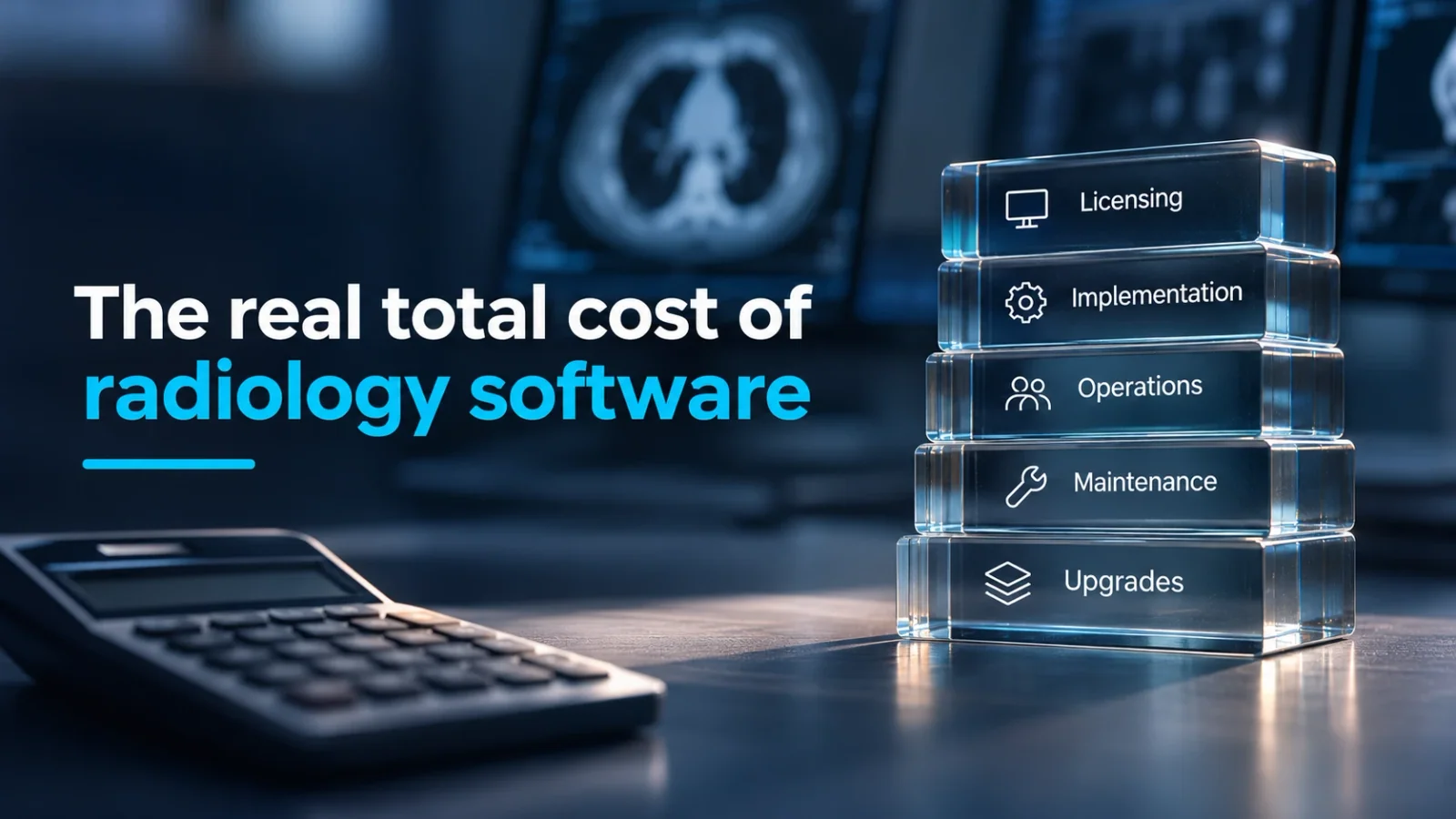
Total cost of ownership, or TCO, is everything a system costs you over its life, not just the licence or the subscription. It includes the integrations you pay someone to build and maintain between the RIS, the PACS and the HIS, the hardware and the people needed to keep an on-site server healthy, and above all the radiologist time lost to slow software. The quotation shows the price. It does not show the minutes.
Good healthcare software takes engineering, clinical understanding, integrations, cybersecurity, monitoring, redundancy, continuous development and dependable support.
Security is now an enterprise risk
And under India's DPDP framework and accreditation requirements around patient information, security and reliability are no longer merely IT concerns.
They are enterprise risks with potentially multi-crore consequences.
DPDP is the Digital Personal Data Protection Act, 2023, with its Rules notified in November 2025. Health images and reports are personal data, and the Act places obligations on the organisation that decides how that data is used, which for a hospital or centre means you, not only your vendor. Most of those obligations apply from around May 2027, after an eighteen-month transition. Accreditation bodies such as NABH also look at how patient information is protected. What exactly applies to your organisation is a question for your counsel, not for a blog post; we have set out the basics in The DPDP Act and your radiology data.
What this means when you evaluate software
If you are choosing radiology software, take my questions into the demo rather than the quotation meeting. A few ways to make them concrete:
- Time saved. Ask a radiologist on your team to report a normal day's mix of studies on the system, start to finish, and compare it with how they work today.
- Priors. Ask the vendor to open a patient with several earlier studies, on your network, and watch how long the priors take to appear.
- End to end. Ask whether registration, scheduling, billing, acquisition, reporting and report delivery run in one system or several, and count the logins a study needs on its way to a signed report.
- Standards and HIS. Ask which standards the system supports (DICOM for images, HL7 or FHIR for messages to the HIS) and ask to speak to a site where the HIS integration is live. Our guide to connecting radiology to the HIS lists the messages that matter.
- Communication. Ask how a referring doctor receives the images and report, and how a radiologist flags an urgent finding, without WhatsApp being the official channel. A link that opens in a browser viewer is a different thing from a photo of a monitor (see Sharing scans with referring doctors).
- AI readiness. Ask how an AI result would reach the radiologist: inside the same viewer and worklist, or as one more login.
- Security and resilience. Ask what happens when the internet goes down, where data is stored, how it is backed up, and how access is logged. The answer will differ between an on-site and a cloud setup, which we compared in Cloud PACS or on-premise?
Then do the multiplication for your own centre: the minutes lost per study, times the studies you report in a day, times the working days in a year, times the years you will keep the system.
So where does that leave a hospital choosing software? The scanner decides what images you can make; the software decides how quickly and how carefully they are read, and that cost runs for as long as you keep the system. We will cover the full list in a separate buyer's checklist for choosing a PACS in India.
Related reading
- Connecting radiology to the HIS — HL7 and FHIR messages, explained for centre owners.
- The DPDP Act and your radiology data — what the law says about images and reports.
- Cloud PACS or on-premise? — the cost and resilience trade-offs of each.
FAQ
What is the total cost of ownership of radiology software?
Everything the system costs over its life: the licence or subscription, plus the time lost to slow viewing, extra clicks, missing priors and multiple logins, multiplied across thousands of examinations, hundreds of clinicians and several years. That hidden cost often outweighs the price on the quotation.
Why is "lowest price" the wrong first question for a PACS vendor?
Because radiology software is core clinical infrastructure, not an accessory to the scanner. A cheaper system that wastes a few minutes per study delays decisions for ER physicians, surgeons, oncologists and ICU teams, and costs more in the end.
What questions should a hospital ask a radiology software vendor?
How much time it saves, how fast priors are on screen, whether it follows interoperability standards and integrates with the HIS, whether it enables secure communication instead of WhatsApp, whether it is ready for AI integration, and how secure and resilient it is.
Does DPDP apply to radiology images and reports?
They are personal data, so the Digital Personal Data Protection Act, 2023 and its Rules are relevant to any hospital or centre handling them. Talk to your counsel about what it requires of your organisation.
Ready to see your workflow on one platform?
We will walk you through the whole workflow, from registration to signed report.