The worklist doesn't care
How it starts
More than 100,000 scans. That's how many I've read in my career. Want to know how many of those patients I actually spoke to?
Not many. Welcome to modern radiology.
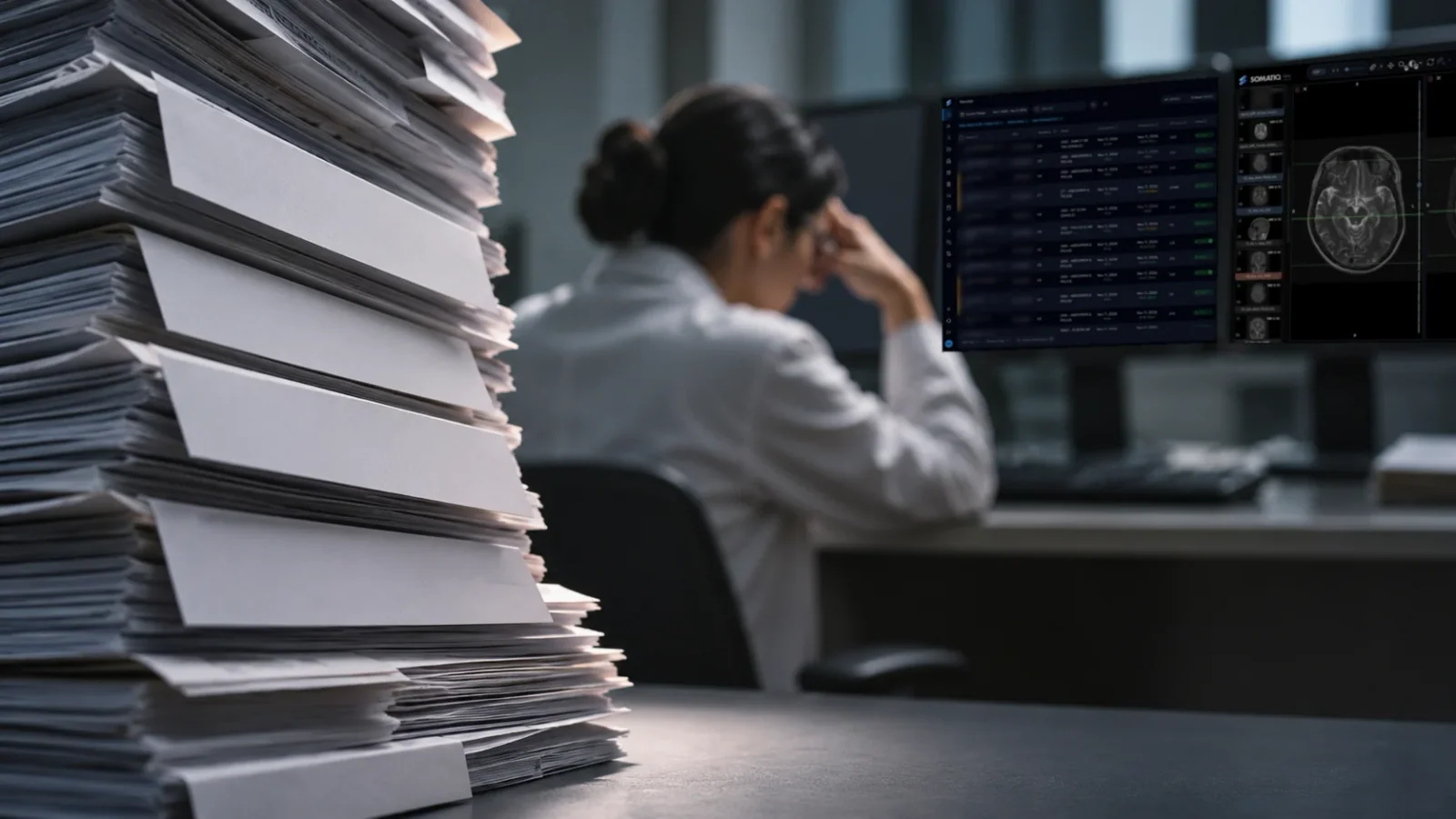
I wrote that on LinkedIn in March 2026, under the title this page carries. It is a shorter and more personal piece than most of what we publish here, and I have kept it as I wrote it. I have added a little context for readers who are not radiologists, and some thoughts at the end for the people who run imaging centres, because the choice it describes is ultimately theirs.
The doctor in the dark room
We have built a system where the doctor with the answers sits in a dark room behind dual monitors, separated from the person whose life depends on those answers.
If you are not a radiologist, the worklist is the queue of studies waiting to be reported, and it is what we look at all day. Each line is a patient, but on screen it is a name, an ID, a modality and a time stamp. You open it, read it, dictate, sign, and the next one is already waiting. Most patients never meet the radiologist who reads their scan; they meet the technologist who scans them and the doctor who referred them, and the report travels between the two. That arrangement has good reasons behind it (it lets one radiologist serve many centres, and it is what makes teleradiology possible), but it has a cost that rarely gets counted.
The weight that comes later
I have dictated cancer cases, closed the reports, and moved to the next scan — only to feel the weight hit me hours later. That wasn't just a "finding." That was someone's father. Someone's daughter.
But the worklist doesn't care.
The question I ask when building
This is why I have chosen to live in the tension between clinical radiology and health technology and constantly ask one question when building systems: does this bring us closer to the patient, or further away?
We are asking the wrong question about AI.
What AI can and cannot do
AI can read, flag, and quantify in seconds. Take out routine tasks. But an algorithm will never sit with a patient to help them understand what a report means for their future.
I have seen it countless times — the report is clear, the findings are evident, yet what finally puts a patient at ease isn't the scan. It's a radiologist saying, "Here's what this means." Medicine isn't just about information — it's about trust.
AI may finally give us back what we lost a long time ago: the time to be present.
I made a related argument a few weeks earlier, in Radiology did not fail AI: that AI's real value lies in augmentation, in triage, measurement and alerts, while interpretation stays with the radiologist. This post is the other half of that thought. If AI does take routine work off our desks, the question is where the time it frees actually goes. And it may come sooner than we expect; I wrote about how compressed these timelines have become in The most compressed decade.
What this means for a centre
For a centre owner or a head of department, this is not only a philosophical point; it is a decision you will face. As software and AI take routine tasks off the radiologist's day (fewer clicks, faster priors, less retyping between systems, the kind of friction Naveen describes in What "AI-native" RIS + PACS actually means), the time saved can go in one of two directions. It can all go back into the worklist, as more studies per hour. Or some of it can go to the patient.
A few things worth thinking about:
- When you evaluate new software or AI, ask the question I ask: does this bring the radiologist closer to the patient, or further away?
- Decide, deliberately, what part of the time saved goes back to patients, for example a radiologist being available to speak with a patient about a significant finding.
- Make it easy for a patient to ask, and for a radiologist to answer, without it being treated as a disruption to the list.
None of this needs a new product. It needs a decision, made by whoever sets the targets for the reading room, that a conversation with a patient counts as work. The worklist will not make that choice for you. It doesn't care.
And in the end, people only remember two things: Kindness and Compassion.
Related reading
FAQ
Why do most patients never speak to their radiologist?
Because of how radiology is organised. The radiologist reads from a reporting room, often away from where the scan was done, working through a worklist of studies. The patient meets the technologist and the referring doctor, and the report travels between them.
What is a radiology worklist?
The queue of studies waiting to be reported. Each entry is a patient, but on screen it is a name, an ID, a modality and a time stamp, and the next study is always waiting.
Will AI make radiologists redundant?
Dr. Vishwanath argues that is the wrong question. AI can read, flag and quantify in seconds and take out routine tasks, but it will not sit with a patient and explain what a report means for their future. The better question is whether AI gives radiologists the chance to be human again.
How can AI make radiology more human?
By reading, flagging and quantifying in seconds and taking out routine tasks, so that radiologists get back the time to be present with the patient and explain what a report means.
Ready to see your workflow on one platform?
We will walk you through the whole workflow, from registration to signed report.