Radiology did not fail AI
Over the last decade, I've watched medical imaging evolve from both sides of the fence, first as a radiologist and later from within the technology ecosystem.
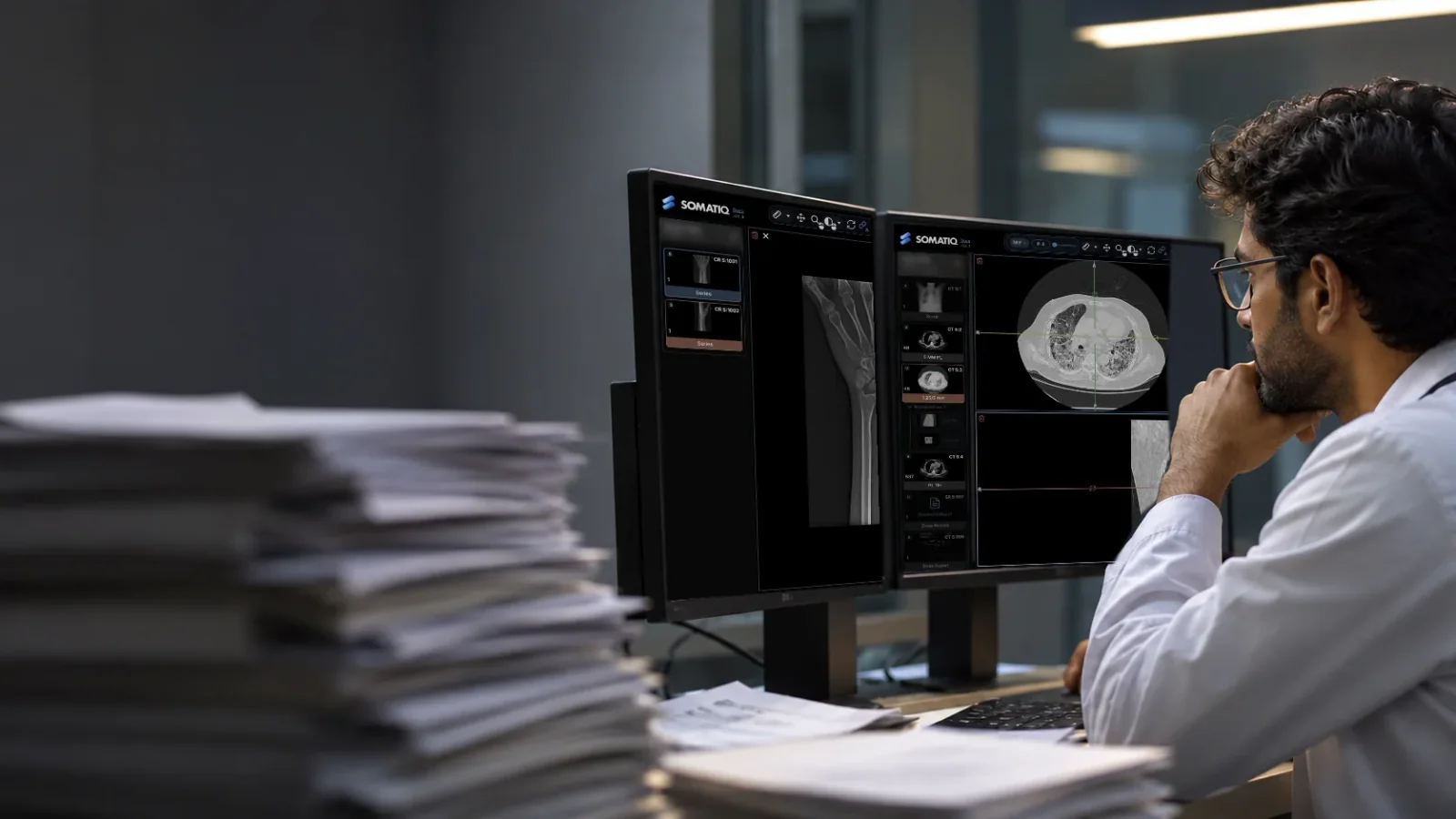
I wrote the post this page is based on in January 2026, ahead of IRIA 2026, where we are showing SOMATIQ in public for the first time. I have kept it largely as I wrote it. Around it I have added some context for readers who do not spend their days in a reading room, and at the end a few questions a centre can ask when someone offers it AI.
The confidence of 2017
Around 2017, AI entered radiology with immense confidence. Algorithms promised efficiency, accuracy, and scale. As time progressed, accelerated by the pandemic, a sobering realisation emerged. We had overestimated the scale and immediacy of AI-driven transformation. It was never going to replicate the cognitive depth of a radiologist. Interpretation is not pattern recognition alone. It is clinical context, correlation, prioritisation, uncertainty management, and judgement under pressure.
It helps to see what each of those words means at the workstation.
Each of these sits around the pixels, not inside them, which is why a model trained only to recognise a pattern on an image is not doing any of it.
Here is the uncomfortable truth:
The uncomfortable truth
"Radiology did not fail AI. AI failed to understand radiology."
What changed after the pandemic
The post-pandemic era ushered in LLM and VLM-based solutions, a development I consider nothing short of revolutionary given the compressed timeline. Not because they are more capable of replacing radiologists, but because they allow us to better understand workflows and build intelligent systems around how radiology is actually practised.
First, a few words on the terms.
The earlier generation of imaging AI was mostly narrow, one model per finding, each trained and validated for a single task. These newer models can be pointed at the work around the image as well as the image itself (the referral, the prior report, the draft of today's report), and that is why I find them interesting.
Augmentation, not replacement
The real value of these systems lies in augmentation, helping radiologists focus on diagnosis rather than software. AI already excels at triaging studies, quantification, and triggering alerts for emergent findings (many excellent vendor solutions already exist and are clinically valuable). Comprehensive interpretation must remain with the radiologist, supported by better tools rather than more interfaces.
In plain terms, triage means a suspected bleed on a head CT moves to the top of the worklist instead of waiting its turn. Quantification means the software measures what a radiologist would otherwise measure by hand, such as a coronary calcium score or a lesion volume. Alerts mean an emergent finding reaches a human quickly. All three help the radiologist, and none of them is the report. Naveen saw the same pattern on the exhibition floor at RSNA a few weeks earlier: the AI drawing interest was the kind that helps radiologists scale, not the kind that tries to be one (he wrote about it in What RSNA 2025 taught me).
Why we started SOMATIQ
This belief led us to start SOMATIQ (SOMA: Body, IQ: Intelligence), with a simple goal: to place intelligence at the centre of radiology workflows and dissolve the boundaries between systems.
Together with my co-founder Naveen K, a brilliant engineer and data scientist, and backed by an excellent team, we have made remarkable progress in bringing this vision to life. We are excited to showcase our platform at IRIA 2026 at HITEX, Hyderabad, and warmly invite you to experience what the future of radiology looks like.
Naveen has told his side of how the company began in Why we built SOMATIQ.
What this means for a centre looking at AI
If you run a centre or a department and someone is offering you AI, the questions that follow from all this are simple:
Does it augment, or does it claim to replace? Triage, quantification and alerts are where AI is clinically valuable today. Be careful of anything that claims to take comprehensive interpretation away from the radiologist.
Is it one more interface? If the AI result lives in a separate window or needs a separate login, the radiologist is now managing software again. Ask whether it appears inside the worklist, viewer and report they already use.
Does it understand context? Ask what the AI sees besides the image: the history, the priors, the previous report. If the answer is "only the pixels", you know what it cannot do.
The point of AI in radiology, as I see it, is to give the radiologist's attention back to diagnosis. That only happens when the AI sits inside the same system as the worklist, the images and the report, rather than beside it. We have written more about how that shapes our platform in What "AI-native" RIS + PACS actually means, and you can see the products themselves at somatiq.ai.
Related reading
FAQ
Why does Dr. Vishwanath say radiology did not fail AI?
Because the first wave of imaging AI, from around 2017, treated interpretation as pattern recognition. Interpretation is also clinical context, correlation, prioritisation, uncertainty management and judgement under pressure, and those early systems were never going to replicate that.
Will AI replace radiologists?
In his view, no. AI already excels at triaging studies, quantification and alerting for emergent findings, but comprehensive interpretation must remain with the radiologist, supported by better tools rather than more interfaces.
What are LLMs and VLMs in radiology?
Large language models work with text such as reports and histories; vision-language models work with images and text together. Their value is that they help us understand workflows and build intelligent systems around how radiology is actually practised.
What does the name SOMATIQ mean?
SOMA means body and IQ means intelligence. The goal is to place intelligence at the centre of radiology workflows and dissolve the boundaries between systems.
Ready to see your workflow on one platform?
We will walk you through the whole workflow, from registration to signed report.