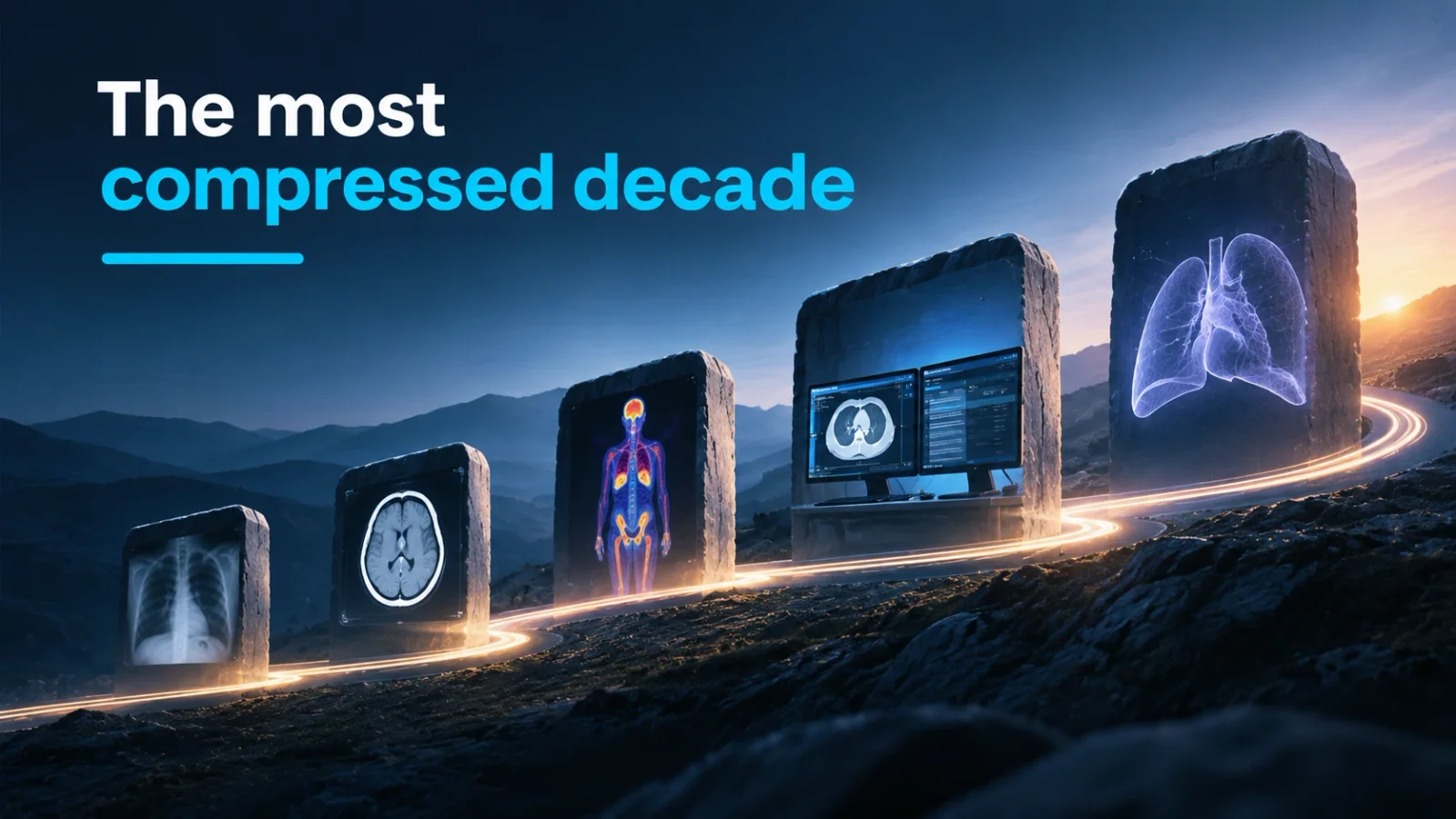
The most compressed decade
For most of human history, change was invisible.
A farmer born in 1200 and a farmer born in 1300 would have lived almost identical lives.
Someone born in 1950 has witnessed radios, televisions, satellites, personal computers, the internet, smartphones, cloud computing, and now intelligent systems.
What once took centuries now takes decades. What once took decades now takes months or even weeks.
I wrote the article this page is based on in February 2026, a few weeks after we showed SOMATIQ at IRIA. It is a broader piece than most of what we publish here, about technology as a whole, but I wrote it as a radiologist, and under each of its main points I have added what I think it means for radiology specifically.
Muscle, knowledge, cognition
The Industrial Revolution mechanised muscle. The Information Age digitised knowledge. We are now entering an era that augments cognition itself.
2020 was a structural inflection point
The pandemic did more than disrupt supply chains. It changed how we work, exposed fragility in global systems, and intensified workforce shortages, particularly in healthcare. At the same time, advances in compute, data, and model architectures pushed AI from research curiosity into everyday utility.
For decades, AI was cyclical. Excitement followed by disappointment. The so-called AI winters.
This phase feels fundamentally different.
I have watched one version of that cycle from inside radiology. Around 2017, AI entered our specialty with immense confidence. Algorithms promised efficiency, accuracy and scale. Within a few years, accelerated by the pandemic, came the sobering realisation that we had overestimated the scale and immediacy of the change. Then, in a very short time, came LLMs and VLMs, the large language and vision-language models. What made them different for me was not that they could replace radiologists. It was that they let us understand workflows and build intelligent systems around how radiology is actually practised. That is the compression I mean: a full cycle of hype, disappointment and renewal inside a few years. (I set out that argument at more length in Radiology did not fail AI.)
Systems that assist thinking
AI is no longer confined to labs. It is embedded in search engines, productivity tools, imaging systems, logistics networks, and software development. We are no longer building tools. We are building systems that assist thinking.
Three shifts for the next decade
The next decade will likely be shaped by three shifts.
Intelligence will become infrastructure, expected in every digital product like electricity is expected in every building.
In radiology, this means AI stops being a separate product you buy and log into. It sits inside the worklist, the viewer and the report, the way the network sits inside the hospital. A radiologist should not have to think about where the AI is. That is the idea behind building RIS, PACS and reporting as one platform, which Naveen explains in What "AI-native" RIS + PACS actually means.
Interfaces will evolve from menus and clicks to conversation and intent.
Anyone who has reported a long list knows what menus and clicks cost. The idea that a radiologist could simply say what they want, and the system would do it, is not a novelty for us. It is attention given back. At IRIA a few weeks ago, the worklist that radiologists can talk to drew as much debate as interest, which is how it should be (see What radiologists told us at IRIA 2026).
Regulation and governance will mature as AI influences decisions in medicine, finance, law, and defence.
In medicine this is overdue. When AI touches a diagnosis, someone has to be able to say what the software did, and who is responsible for the report.
What this means for healthcare
In healthcare, this could mean earlier detection, reduced diagnostic error, and more accessible expertise. As a radiologist, I see this first-hand. The volume and complexity of imaging studies continues to grow while the workforce does not. AI is not replacing the radiologist. It is becoming the co-pilot that makes sustainable practice possible.
Sustainable is the important word. If AI can triage, quantify and flag the urgent study, it takes some of that weight off the person reading, and the radiologist can spend their attention on diagnosis rather than software.
The deeper shift
But the deeper shift is philosophical.
For the first time, we are scaling reasoning itself.
If the Industrial Age expanded physical capability, and the Information Age expanded access to knowledge, the AI Age may expand applied intelligence.
The question is not whether this transformation will occur. The question is how responsibly, how equitably, and how quickly we shape it.
We are living in one of the rare moments in history where the trajectory of entire professions can change within a single decade.
That is both unsettling and extraordinary!
For a hospital or a centre, the practical upshot is modest but real: choose systems in which AI can live inside the radiologist's existing workflow, and in which it is always clear what the software did and who signed the report. Those are the two conditions under which the changes above help rather than distract. You can see how we have approached them at somatiq.ai.
Related reading
- Radiology did not fail AI — the 2017 wave, and what LLMs and VLMs change.
- What "AI-native" RIS + PACS means — intelligence as infrastructure, in practice.
FAQ
Why was 2020 a turning point for AI?
The pandemic changed how we work, exposed fragility in global systems and intensified workforce shortages, especially in healthcare. At the same time, advances in compute, data and model architectures pushed AI from research curiosity into everyday utility.
What are the three shifts expected in the next decade?
Intelligence becoming infrastructure, expected in every digital product; interfaces moving from menus and clicks to conversation and intent; and regulation and governance maturing as AI influences decisions in medicine, finance, law and defence.
Will AI replace radiologists?
Dr. Vishwanath's view is that AI is not replacing the radiologist but becoming the co-pilot that makes sustainable practice possible, as the volume and complexity of imaging grows faster than the workforce.
What does "scaling reasoning" mean?
The Industrial Age expanded physical capability and the Information Age expanded access to knowledge. The AI Age may expand applied intelligence, which is why the trajectory of entire professions can change within a single decade.
Ready to see your workflow on one platform?
We will walk you through the whole workflow, from registration to signed report.