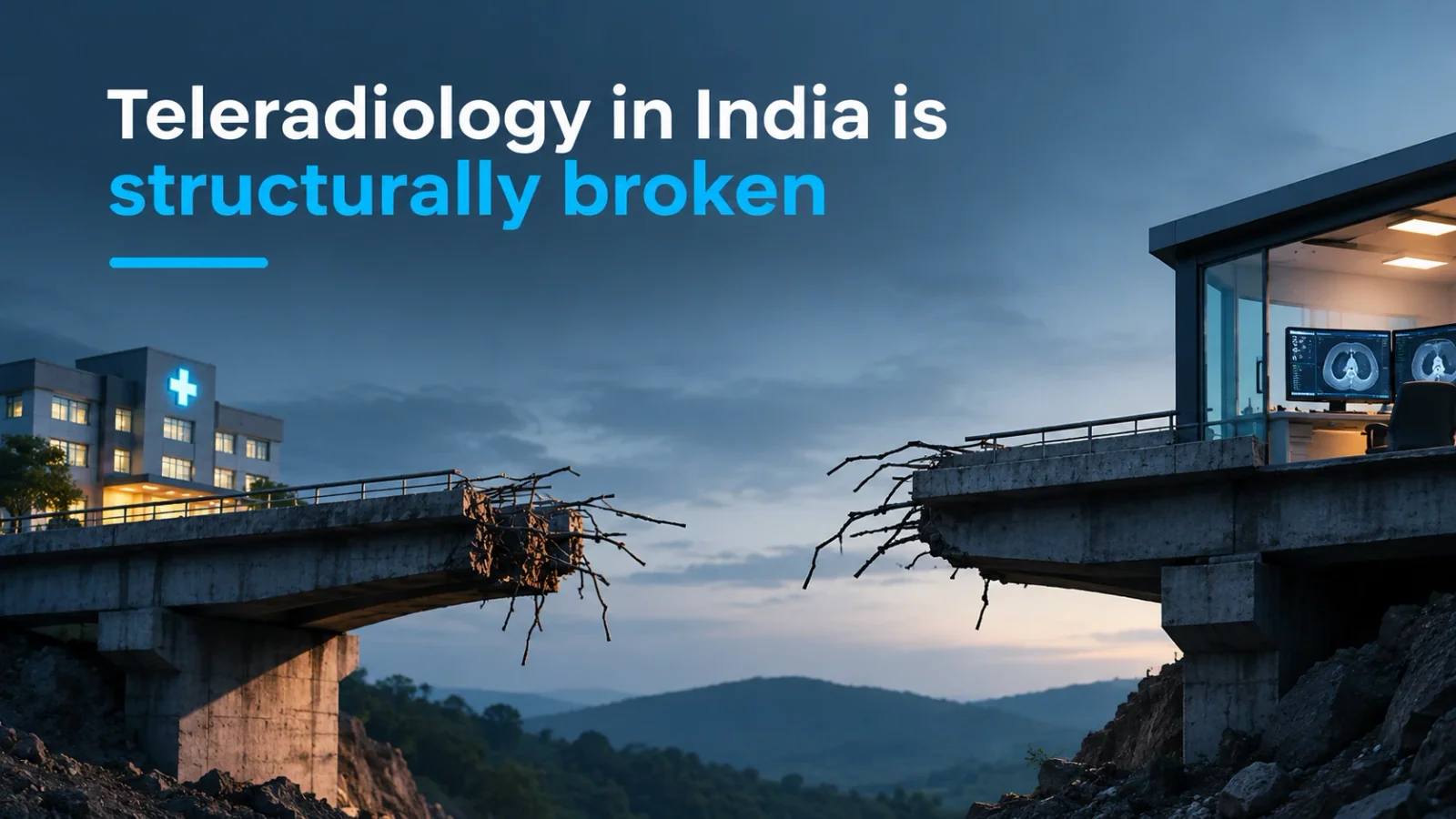
Teleradiology in India is structurally broken
The argument
When diagnosis becomes a commodity, patients pay the real price.
Teleradiology in India is structurally broken.
I wrote that on LinkedIn earlier this year, and it drew more responses than almost anything else I have posted. This page keeps what I wrote. Around it I have added some context for readers who are not radiologists, and a few practical questions at the end for anyone who sends studies out for reporting.
First, what teleradiology is
Teleradiology simply means the images are acquired in one place and reported in another. A CT is done at a hospital or diagnostic centre, the images are sent over the internet, and a radiologist sitting elsewhere, in another city or sometimes another country, reads them and sends back a report. The software that carries this is usually a teleradiology platform: it receives the study, puts it on a reading radiologist's worklist, gives them a viewer and a reporting screen, and returns the signed report to the centre.
Done well, it extends reporting to places that would otherwise have none. A small centre without a full-time radiologist can still offer CT. A hospital can get night cover. A subspecialist in one city can report a difficult case from another. The advantage of the model is reach; its weakness is that the person who signs the report is invisible to the patient and often to the hospital as well. The problem is not the idea. The problem is what the market has done to it.
The race to the bottom
Someone decided a radiology report is just text. That it can be produced faster, cheaper, by anyone. That the radiologist behind it doesn't matter. Possibly it does not even require a radiologist.
And so the race to the bottom began.
Dr. Vishwanath R S, LinkedIn post, March 2026
Turnaround promised in minutes. Not because quality allows it, but because the business model demands it. Volume is the only way to survive. And volume at that pace means corners aren't cut. They're eliminated.
A word on turnaround, since it is the number teleradiology is usually sold on. Turnaround time, or TAT, is the time from when the scan is done to when the signed report reaches the referring doctor. It matters; for a stroke or a head injury, minutes are real. But a CT abdomen is not a text message. A careful read means going through every series, comparing with the patient's earlier scans (we call them priors), and thinking about what the clinician actually needs to know. When the price is that low and the promise is minutes, something in that list has to go, and it is usually the comparison with priors, because that is the step nobody outside radiology can see is missing. (I wrote about what the worklist does to that kind of attention in The worklist doesn't care.)
No one is accountable
No teleradiology-specific oversight. Medical registration and professional-conduct rules apply to every radiologist, but there is no enforceable framework governing who reads what, from where, with what credentials. A report goes out. If it's wrong, who is responsible? Nobody knows. Nobody asks. Until something goes terribly wrong.
Dozens of teleradiology companies competing purely on price. Many failing. Some barely surviving. All dragging the market down with them.
The AI question nobody is asking
Some companies advertise "AI reporting." But nobody knows whether the report was reviewed by a qualified radiologist or simply annotated by some person. The ambiguity is the feature, not the bug.
To be clear about what that means for the reader: a report can carry the words "AI reporting" and still leave you with no way to tell who, or what, actually produced it. AI has a real place in radiology, in triage, measurement and alerts for urgent findings, and I have written about where I think it belongs in Radiology did not fail AI. Its place is beside a radiologist who reads the study and signs the report, not in place of one.
The real cost
Genuine talent suffers in the middle of this. Radiologists who trained for years, who understand that a missed finding changes a life, are being told their work is worth less than ₹100. They watch the market reward speed over skill, volume over value. Many are quietly concluding their expertise is better appreciated outside this country.
That is the real cost. Not just bad reports. A slow erosion of the profession itself.
Is there light at the end?
It won't come from the market correcting itself. It never does in healthcare.
It will come from hospitals demanding transparency. From radiologists refusing to participate in systems that devalue their expertise. From regulation that is long overdue.
The mess is real. But it's not irreversible.
What this means if you run a hospital or a centre
Regulation will take its time. Transparency is something you can ask for today. If you send studies out for reporting, these are the questions my post is really asking, put plainly:
- Who reads my studies? Can the provider tell you, for any given report, the name of the radiologist who signed it and their qualification and registration?
- From where? Is the reading radiologist in India or outside, and is that disclosed to you?
- Was AI involved, and how? If software generated or drafted any part of the report, did a qualified radiologist review it before it was signed?
- Who is responsible if a report is wrong? This should be written into your agreement, not discovered after an incident.
- What does the turnaround promise actually cover? Ask how the provider manages a CT reported in minutes without dropping the comparison with priors.
None of these questions is unreasonable, and a provider who takes its work seriously will be able to answer each of them from its own system, because the platform it reports on should record who opened the study, who signed it and when. We will put together a fuller guide to choosing a teleradiology partner in a later post. For how a single platform keeps that record from the scanner to the signed report, see What "AI-native" RIS + PACS actually means, and for our own teleradiology platform, somatiq.ai/teleradiology.
The question is whether we care enough to fix it before the damage becomes permanent.
Related reading
- The worklist doesn't care — the distance between the radiologist and the patient.
- Radiology did not fail AI — where AI helps the radiologist, and where it does not belong.
FAQ
Why does Dr. Vishwanath say teleradiology in India is structurally broken?
Because the market has been built on price and volume. With reports priced at a fraction of their worth, turnaround promised in minutes, and no teleradiology-specific framework on who reads what, from where and with what credentials, quality and accountability are the first things to go.
Is teleradiology itself the problem?
No. Reporting images remotely lets centres without a full-time radiologist offer CT, gives hospitals night cover and brings subspecialists to cases in other cities. The problem is a business model that treats the report as text that anyone can produce.
What is TAT in radiology?
Turnaround time: the time from when a scan is done to when the signed report reaches the referring doctor. Fast TAT matters for emergencies, but a TAT that leaves no time to review priors or every series is a warning sign.
What should a hospital ask a teleradiology provider about AI reporting?
Whether AI was used in producing the report, and whether a qualified radiologist reviewed and signed it. If the provider cannot answer clearly, treat that ambiguity as the answer.
Ready to see your workflow on one platform?
We will walk you through the whole workflow, from registration to signed report.