How to choose a teleradiology partner
Most centres pick a teleradiology partner the way they pick a courier: whoever is cheapest and promises the fastest delivery. That works for parcels. It does not work for a report that decides whether a patient goes to the cath lab or goes home. The usual buying process makes this worse, because the two numbers on a quote (rate per study and promised turnaround) are the easiest to compare and the least informative about quality.
Our co-founder Dr. Vishwanath R S, a practising radiologist who has read more than 100,000 scans, wrote about this bluntly in a LinkedIn post in March 2026, which we published here as Teleradiology in India is structurally broken. It started with the line "When diagnosis becomes a commodity, patients pay the real price." This guide starts from his argument and then turns it into questions you can put to any provider of teleradiology services in India.
What has gone wrong
On what went wrong
"Someone decided a radiology report is just text,"
"That it can be produced faster, cheaper, by anyone. That the radiologist behind it doesn't matter."
On price and speed
He described the result as a race to the bottom on price per report.
"Turnaround promised in minutes. Not because quality allows it, but because the business model demands it."
On AI reporting
He also pointed at something most buyers do not ask about.
"Some companies advertise 'AI reporting.' But nobody knows whether the report was reviewed by a qualified radiologist or simply annotated by some person."
On the fix
His view of the fix is the reason this guide exists.
"…won't come from the market correcting itself,"
"It will come from hospitals demanding transparency."
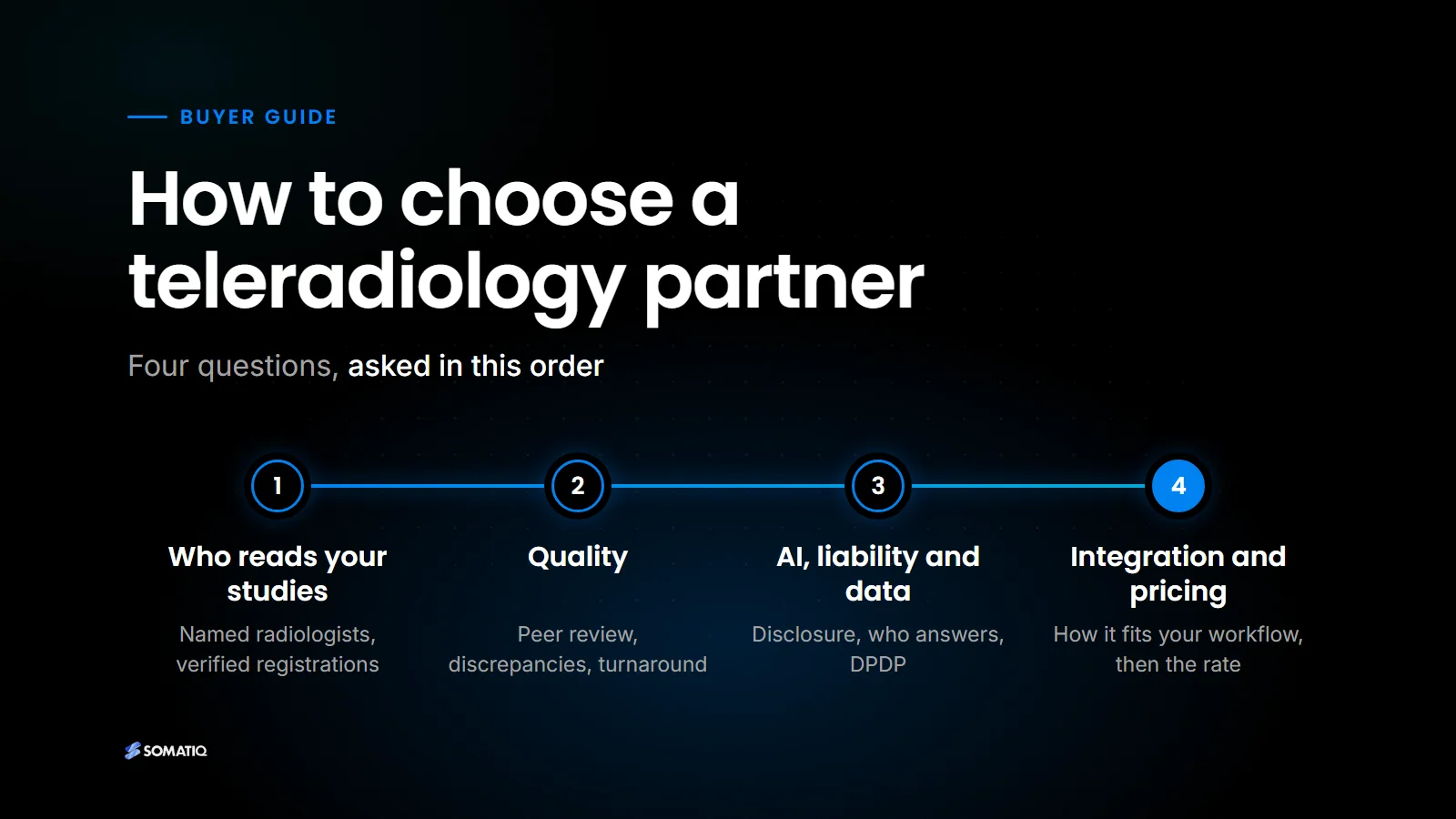
So, let's look at what demanding transparency means in practice, in the order we would ask the questions.
Who reads your studies, and how you know
This is the first question and the one that gets the vaguest answers. "A panel of 200 radiologists" tells you nothing. A provider worth signing with should be able to give you the following:
- Named radiologists, with their qualifications (MD or DNB in radiodiagnosis, or equivalent) and any fellowship or subspecialty training.
- Their medical council registration numbers. Every report should carry the name and registration number of the radiologist who signed it.
- Who reads what. Will your MR brain go to a neuroradiologist, or to whoever is next in the queue? Is there subspecialty cover for MSK MR, cardiac CT, fetal imaging, paediatrics? At what hours?
- Whether the person who signs is the person who read. If a junior or a non-radiologist drafts and someone else signs, you should know.
Do not take a PDF of certificates on trust. Check registrations yourself against the Indian Medical Register on the NMC website or the relevant State Medical Council. The NMC is building a single National Medical Register; ThePrint reported in October 2026 that the national portal was expected to go live in stages, with full public search taking longer as state registers are integrated. Then ask the provider how they verify a new radiologist before giving them access, how often they re-check, and what happens when someone leaves. A radiologist who left six months ago should not still have a login.
Quality: peer review, discrepancies and turnaround
Every radiologist makes errors. The question is whether the provider looks for them. Ask what percentage of reports are peer reviewed, and whether they are picked at random or targeted at high-risk studies. Ask what scoring system is used; many programmes use something like the ACR's RADPEER scoring, which grades disagreements by how understandable the miss was and whether it was clinically significant. Ask whether they will share discrepancy rates with you, by modality, every quarter, and what happens to a radiologist whose discrepancy rate is high. A provider that cannot answer these questions does not have a QA programme; it has a hope.
Sooner or later your clinician will disagree with a report, so find out in advance how that is handled:
- Who do you call, and is there a radiologist on the other end at 2 a.m.?
- How quickly is an addendum issued, and does the original stay visible with the change tracked?
- Is there a root-cause review for significant misses, and do you see the outcome?
Turnaround needs the same scrutiny. Ignore headline TAT figures. Ask for turnaround by modality and by priority (emergency, routine) for the last three months, measured from the time the study reached the provider to the time the signed report reached you. Ask for the median and the 90th percentile, not just the average, because the average hides the 3 a.m. queue. Our guide to radiology turnaround time breaks TAT into the stages worth measuring.
Then ask the uncomfortable question Dr. Vishwanath raised: how many studies does each radiologist read per shift? A promised turnaround that only works if one person reports at a pace no one can sustain is not a service level. It is a risk you are taking on.
AI, liability and your patients' data
AI can be useful in teleradiology for triage, flagging critical findings and measurements (our post on AI triage on the worklist explains how a triage result should feed the queue without taking it over). The problem is non-disclosure. Ask which AI tools are used, on which studies and for what; whether a qualified radiologist reviews every image and signs every report, or whether some reports are issued on AI output alone; and whether the report will state that AI was used. India's ICMR ethical guidelines for AI in healthcare say humans should keep control of AI in medical decision-making and that patients should be informed of the extent to which AI was used. Ask your provider to commit to both in writing.
On liability
"If it's wrong, who is responsible? Nobody knows. Nobody asks."
When a report is wrong, who answers for it? Ask now, not after something goes wrong. Your contract should say who the reporting radiologist is in law for each report, whether the provider and each radiologist carry professional indemnity cover and for how much, how complaints and legal notices are handled, and how long the provider keeps reports, images and audit logs. Have your counsel read this part. Our guide is not legal advice.
Your teleradiology partner also handles your patients' personal data. Under the Digital Personal Data Protection Act, 2023, your centre remains responsible for compliance even when someone else processes the data for you (section 8(1)), and the DPDP Rules, 2025 expect breaches to be reported to the Data Protection Board and to affected patients without delay, followed by a detailed report to the Board within 72 hours (Rule 7). Most of these Rule obligations apply from around May 2027. Ask where images are stored and read from, whether any radiologists read from outside India, how access is controlled and logged, and how fast the provider will tell you about a breach. Studies and reports should move over a secure platform, not personal WhatsApp or email (see sharing scans with referring doctors for why). Our DPDP guide for imaging centres covers processor contracts and breach duties in more detail.
Who says what
On AI
Humans should keep control of AI in medical decision-making, and patients should be told how far AI was used.
On responsibility
Your centre remains responsible for compliance even when someone else processes the data for you.
On breaches
Report to the Data Protection Board and to affected patients without delay, then send a detailed report to the Board within 72 hours.
Integration and pricing models
A cheap read that your staff then have to download, retype and upload is not cheap. Ask whether the provider can:
- receive studies directly from your PACS over DICOM, without manual uploads;
- see the requisition, clinical history and priors with the study;
- send the signed report back into your RIS or HIS automatically, in your template and letterhead;
- show you the worklist status of every study in real time.
Teleradiology is usually priced per study, with rates varying by modality and urgency. Some providers offer a monthly retainer for night or weekend cover, or a premium for subspecialty reads. Compare like with like: a per-study rate that excludes priors, addenda or emergency reads can end up costing more. Price matters. But if a quote looks too good, ask Dr. Vishwanath's question about who is really behind the report.
Where SOMATIQ fits
TelePractice, our teleradiology platform, is built so that most of the questions above have visible answers rather than promises. Studies come from the centre's archive with the order, clinical history and priors attached; the reading radiologist works in the same browser viewer and reporting tools as an in-house colleague; the signed report goes back into the centre's workflow, which on our platform runs end to end from registration, scheduling and billing through acquisition, reporting and report delivery. A peer review queue sits inside the same system, so quality review is part of the workflow rather than a spreadsheet kept on the side.
The practical upshot is that choosing a teleradiology partner is less about the rate card and more about what you can see.
Before you negotiate the rate, ask whether the provider can…
Related reading
- Teleradiology in India is structurally broken — Dr. Vishwanath's original argument.
- Radiology turnaround time — the seven stages worth measuring.
- The DPDP Act and your radiology data — processor contracts and the 72-hour breach report.
- AI triage on the worklist: IHE POWR — how AI results should influence reading order.
- How to choose a PACS in India — the platform side of the same decision.
- Radiology in India is commoditised — why price-led buying hurts quality.
FAQ
What should I ask a teleradiology provider in India before signing?
Ask who reads your studies by name and registration number, how credentials are verified, how peer review works, what turnaround they achieve by modality, how AI is used and disclosed, who carries medico-legal responsibility, how data is secured under the DPDP Act, and how they integrate with your RIS-PACS.
How do I verify a teleradiologist's registration?
Ask for the State Medical Council or NMC registration number and check it against the Indian Medical Register on the NMC website or with the relevant State Medical Council.
Is AI-only reporting acceptable?
India's ICMR guidelines on AI in healthcare say humans should retain control of AI in medical decision-making and that patients should be told how far AI was used. Insist that a qualified radiologist reviews and signs every report, and that AI use is disclosed.
What is a realistic turnaround time for teleradiology?
It depends on modality, priority and staffing. Ask for the provider's actual median and 90th percentile turnaround by modality over recent months, rather than a headline figure.
Ready to see your workflow on one platform?
We will walk you through the whole workflow, from registration to signed report.